New study makes the link between study abroad and employability
Amidst a backdrop of considerable concerns around youth employment in many parts of the world, a new European Commission study released this month finds that young people who study or train abroad not only gain knowledge in specific disciplines, but also strengthen key skills highly valued by employers.
The Erasmus Impact Study: Effects of mobility on the skills and employability of students and the internationalisation of higher education institutions finds that internationally mobile students are half as likely to experience long-term unemployment compared with those who have not studied or trained abroad and that, five years after graduation, their unemployment rate is 23% lower.
The study sets out to measure the impacts of the recently reinvigorated Erasmus student mobility programme in Europe. Under new budget commitments concluded in December 2013, the expanded programme will provide funding for more than four million people to study, train, work, or volunteer abroad through 2020.
Erasmus+ is the world’s most ambitious student mobility programme and the new impact study is correspondingly impressive in its scope. The findings are based on a series of five online surveys conducted in 2013 and with a combined sample size of nearly 80,000 individual responses. These include 56,733 students (mobile students with and without Erasmus experience as well as non-mobile students), 18,618 alumni (83% mobile with and without Erasmus), 4,986 staff (academic and non-academic, mobile and non-mobile), 964 higher education institutions, and 652 employers across the 34 countries participating in the programme.
"The findings of the Erasmus Impact study are extremely significant, given the context of unacceptably high levels of youth unemployment in the EU,” said Androulla Vassiliou, European Commissioner for Education, Culture, Multilingualism and Youth. “The message is clear: if you study or train abroad, you are more likely to increase your job prospects."
The study notes that 85% of Erasmus participants want to study or train abroad in order to enhance their employability. And a good thing too because, as the report also highlights, employers are looking for that international experience and the skills and perspectives that come with it.
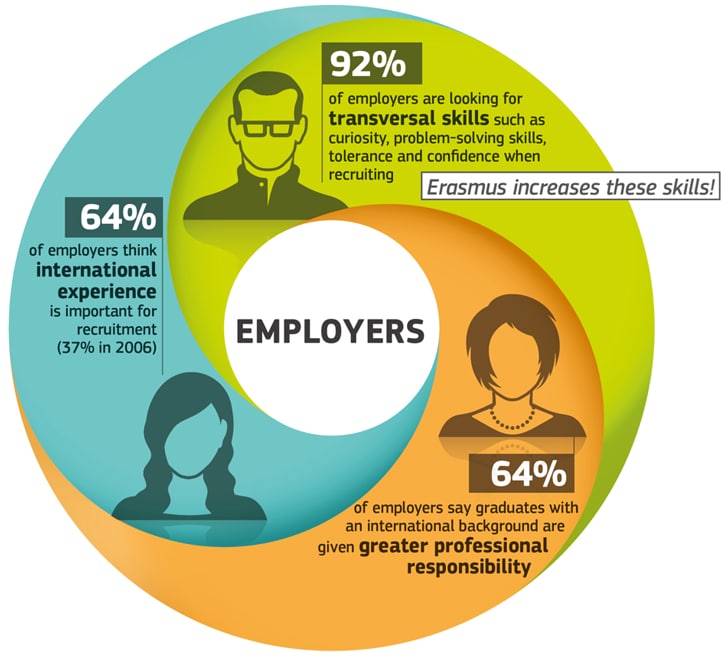
Employers’ perspective on study abroad. Source:
The survey results indicate that 92% of employers are looking for personality traits found to be enhanced by study or training abroad, such as tolerance, confidence, problem-solving skills, curiosity, knowing one's strengths/weaknesses, and decisiveness. The report adds, “Tests before and after exchange periods abroad reveal that Erasmus students show higher values for these personality traits, even before their exchange starts; by the time they come back, the difference in these values increases by 42% on average, compared with other students.”
The report also finds some direct outcomes arising from Erasmus training programmes with respect to employment and entrepreneurship. More than one in three participants in training abroad are offered a position at the enterprise where they do their traineeship. Further, “One in ten international trainees has started their own company and more than three out of four plan to, or can imagine doing so.”
The importance of these findings is driven home by the context in which they are released this month. There is ample evidence of significant and persistent labour market gaps - that is, mismatches between the skills that students graduate with and those that employers require - as well as high levels of youth unemployment in many parts of the world that continue to hold the attention of political and economic leaders. Left unchecked, these issues represent major challenges to social and economic development for a number of countries and regions.
These large questions were taken up again recently at the annual EAIE conference in Prague. A preamble for one of the conference dialogues (“Are university graduates fit for purpose?”) sets out the challenge succinctly:
“The demand for higher education is increasing rapidly on many continents, and there is no shortage of emerging graduates. Corporations and the business sector are competing for young, competent graduates while in contrast, many countries face huge young adult unemployment rates. Why is there such a distinct mismatch in the labour market? Latest indications show that the business sector is not happy with the skills of emerging graduates. Many programmes have not changed over time and much of the hard content of programmes becomes obsolete within two to three years. Graduates are also lacking the transferable (soft) skills which companies value so highly.”
The EAIE panelists highlighted the challenges of teaching or otherwise encouraging entrepreneurship as well as the difficulty of adapting education systems quickly enough to keep pace with rapidly changing labour markets. "The problem,” noted Central European University’s Liviu Matei, “is not with the students, it is with the academia."
The panelists concurred in the end as to the importance of exposing students to international experience. Indeed, their discussion is well supported by the evidence in this month’s European Commission report and by its strong findings as to the key role that study or training abroad plays in both skills development and employability.
For additional background on this important topic, please see our recent related posts: