
New Zealand’s international enrolment up 12% as number of prospective domestic students falls

New data released last month shows that New Zealand, already a popular study abroad destination, has boosted its international student enrolments by 12% for the period January to August 2014 compared to the same period from 2013. This welcome increase coincides with news that fewer domestic students are achieving the required standard to be accepted into New Zealand universities – requirements that became more rigorous in 2014 as a result of new standards established by the New Zealand Qualifications Authority ().
10,000 more international students in New Zealand
The 12% increase in international students equates to just over 10,000 additional foreign students in New Zealand year-to-date August 2014, compared to the period from the previous year. The country’s beauty, quality universities (all eight of its universities are currently in the QS Top 500 ranking of global universities); welcoming visa and postgraduation work policies; well-supported English-language study (students are able to work while studying at NZQA Category 1 providers); and vocational and pathway programmes are positioning New Zealand as a solid choice among English-speaking study destinations. The international education sector now brings in NZ$2.85 billion a year (or US$2.13 billion), making it the country’s fifth most valuable export industry, and one that supports more than 30,000 jobs.
India and China dominate international student population
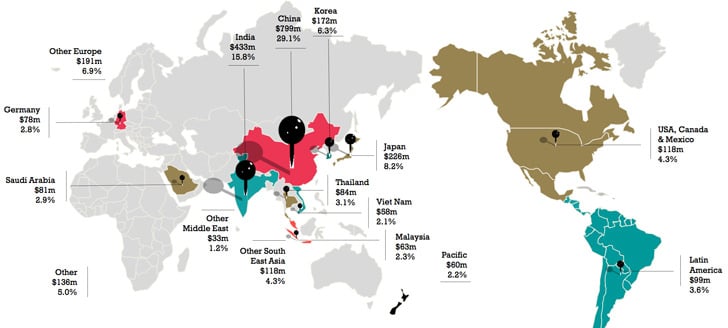
As for where international students are coming from, the main sources are China and India, with South Korea a distant third. However, the Chinese share fell slightly from 32% in 2012 to 29.1% in 2014, while the Indian share shot up from 10.5% to 15.8% (a 50% increase).
According to Education New Zealand, first-time study visas issued to Indian students spiked dramatically in 2014,. Most Indian students in New Zealand are enrolled with private tertiary institutions (70%) and 20% are studying at polytechnics. Education New Zealand’s Acting Chief Executive, John Goulter, said recently, “Most of the demand from India was , and that was why most enrolments had been in the private and polytechnic sectors.”
The large proportion of Chinese international students in New Zealand, meanwhile, reflects a larger trend of closer China-New Zealand ties in many areas, including business and tourism. New Zealand signed a Free Trade Agreement with China in 2008 - the first country to do so - and .
Domestic students face more rigorous standards
Much is being written right now about the fact that in 2014, only 58% of students who completed their final year of secondary school in New Zealand achieved a university entry (UE) score - that is, the academic standing required for university admission. This is down from 70% in 2013. The smaller pool of domestic prospects reflects a . It requires that students achieve National Certificate of Educational Achievement (NCEA) Level 3, where previously they had needed only NCEA level 2. There was also an increase in the number of credits required from a list of approved subjects, from 14 credits in each of two subjects from a list of approved subjects to 14 credits in each of three subjects. Finally, students need 10 level 1 credits to demonstrate numeracy and 10 level 2 credits as proof of literacy. The tougher entrance requirements – first announced in 2011 – were endorsed by New Zealand’s universities, which were concerned that students were coming to them underprepared, making it less likely for them to succeed and graduate. The decision to make the standards more stringent :
- A year in which 22% of Maori and Pasifika students and 11% of European students dropped out after their first year;
- Data showing that students who came into university with NCEA level 3 performed significantly better than students with only NCEA level 2.
Universities New Zealand Executive Director Andrew Whelan said that in the past, there were too many students dropping out of university because they did not have the academic capabilities required to succeed, which he said was “unfair.” He said, "UE is supposed to be a way of signalling that you are ready for university and if you apply yourself you'll probably succeed." Most expected the pass rate to fall in 2014; Minister of Education Hekia Parata noted, “Any time a standard is raised, numbers qualifying will drop.” She continued: “It is not in the interests of any students to begin their university studies without the skills or experience necessary to succeed." But there appears to be a general consensus that the pass rate fell more dramatically than predicted. Some suggest the new standards were not well enough communicated in some high schools, and after a general call to review the sharper-than-expected fail rate, the Qualifications Authority, responsible for setting the university entrance standard, says it will hold a review to examine the factors responsible for the drop in students who qualified for UE. Mr Whelan added: “We think the standards are right, and we would just hope in future that students get the right advice and that poor advice wasn't a factor in them missing out."
Support for students who missed the standard
. For example, Victoria University vice-chancellor Grant Guilford said that his university was working with about 175 students who did not gain UE in 2014. He said many would still be able to attend university this year, though some would have to take extra courses with their school or at the university to be accepted. And Universities New Zealand’s Andrew Whelan said those students who hadn't gained entrance could appeal and ask for review, and that universities could still admit those students at their discretion. He commented:
"Obviously we're wanting to make sure every young person that has the ability is able to get into university."
As for the universities faced with the lower number of eligible students for admission, in recent years their funding has become less dependent on their enrolment numbers, and they have indicated their commitment to a process in which students have the best chance of succeeding in and graduating from their institutions.







