91ɬÂþ

Market intelligence for international student recruitment from ICEF

91ɬÂþ

17th Jun 2015

Using social media to reach students in the Middle East and North Africa

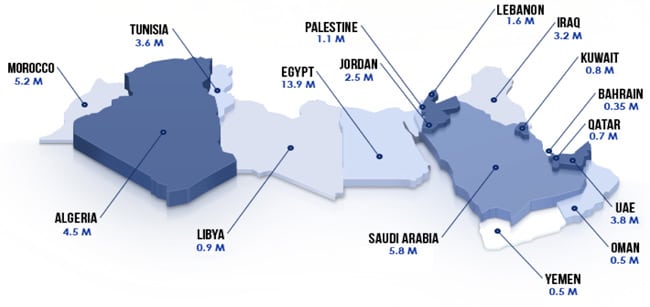
Roughly four in ten international students say that social media influenced their decision to study abroad. Around half read comments about institutions they were interested in on institutional profile pages on social networks. Others checked out the online profiles of other overseas students, gathered recommendations for where to study from friends online, or were exposed to related advertising on social sites. One in four chose to contact institutions directly via their social media accounts. These are some of the findings from an annual survey of international students conducted by . IDP’s Manager, External Affairs, Kim Dienhoff, presented high-level findings from four years of survey data at the recent NAFSA conference in Boston, Massachusetts. The session focused in large part on reaching students in the Middle East and North Africa (MENA). With nearly a third of the region’s 355 million people aged 15 to 25, it is perhaps not surprising that Internet usage, and the penetration of social networks in particular, is high. Ms Dienhoff paired the IDP survey data with additional research to provide an important summary of social media habits and trends in the region. Social media usage in MENA was particularly visible during the pro-democracy protests of the Arab Spring beginning in 2011, leaving many observers with the impression that major global networks, such as Facebook and YouTube, are widely used across the region. Internet penetration is high with nearly 90% indicating they access the web from home. A much smaller proportion (34%) say they have Internet access at work. "For marketers this probably means that you need to schedule online activities like chat rooms, Skype sessions, virtual fairs, or webinars in the evening once people are home from work," notes Ms Dienhoff. There are of course variations from country to country. Internet penetration varies from 85-90% in Bahrain, the UAE, and Qatar to, at the lower end of the range, 44-50% in Jordan and Egypt. Nearly nine in ten Internet users in MENA use social media every day. Smartphones account for 40% of web impressions in the region (about 45% above the global average), and smartphone penetration ranges from a low of 16% in Morocco to 73-75% in the UAE and Qatar. It is fair to say that, at these levels of adoption, a mobile responsive site is a must for reaching students and parents in the region.

Facebook is your #1 friend

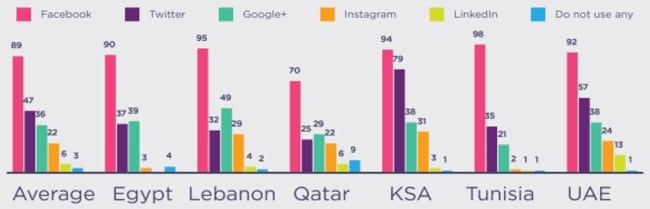
As the following chart illustrates, Facebook is the leading network with a 89% penetration among MENA Internet users. Twitter and Google+ are a distant second and third respectively, but each nevertheless has been widely adopted as well. As with the Internet and mobile usage patterns we noted earlier, the chart reflects national variations as well, including the notably high levels of Twitter usage in Saudi Arabia. mena-top-social-media-networks Top five social networks in MENA and selected markets by percentage of Internet users. Source: IDP Adoption rates are helpful in looking at relative usage from market to market but the absolute numbers of users on each service is arguably the key metric. The following chart reflects the population of Facebook users by country, and illustrates that Egypt, Saudi Arabia, Morocco, Algeria, Iraq, and the UAE have some of the largest populations in the region that are active on this leading social network. MENA-facebook-users Population of Facebook users by country, 2013. Sources: IDP, Arab Social Media Report-2013 This variance in user counts by market is notable in part because each country carries with it its own language preferences. English and Arabic are by far the most-preferred languages among the region’s Internet users, with the exception of markets such as Algeria, Morocco, and Tunisia where French is the clear language of choice.
Beyond Facebook

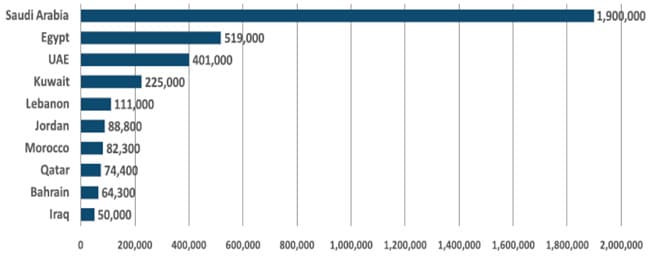
Twitter has also been widely adopted by MENA Internet users and the following chart provides a summary of Twitter user counts for selected markets across the region. MENA-twitter-users Twitter user populations by country, 2013. Sources: IDP, Arab Social Media Report-2013 As the chart illustrates, Twitter is especially well used in Saudi Arabia. The Kingdom accounts, on average, for roughly 47% of all Twitter traffic in the region. And, influenced by the fact that half of the Saudi population of Internet users prefers to use Arabic online, 74% of all Tweets by MENA users are in Arabic (as compared to only 18% in English). YouTube, while not a social network as such, is one of the largest and most heavily used sites on the Internet, and its content is easily and widely shared on social media. It happens that this leading global video service is also extremely popular in many MENA states. YouTube reach in MENA. Source: IDP YouTube is the second or third-ranked site by usage in Saudi Arabia, Egypt, the UAE, and Morocco. Across the region, there are 300 million YouTube playbacks each and every day, and Saudi Arabia leads the pack as the #1 market in the world in terms of views per capita. "YouTube of course is highly valuable to marketers," says Ms Dienhoff. "So if you don’t have a YouTube channel you should probably get one. You can use it to house videos that are then used on many other platforms and of course it will help greatly with your SEO."
Implications for marketers

As the preceding charts and figures clearly reflect, social media usage in the region is highly concentrated around the most-popular social networks and social content sites in the world, including Facebook, Twitter, and YouTube. "The good news is that they are using the same platforms you are already familiar with," adds Ms Dienhoff. (Not to mention that you can reach the vast majority of prospects in the region in English and Arabic.) For additional trends and best practices in social media, please see our post "Facebook is still the top social network but other platforms are growing faster." It includes links to some of our most-popular posts on social media strategy, including tips for Facebook, Twitter, and social video.

Most Recent

  • Australia: Decline in international higher education commencements projected for 2026 Read More
  • The outlook for Indian student mobility through 2030 Read More
  • Well-being and pastoral care in TNE: Supporting students to thrive across borders Read More

Most Popular

  • Which countries will contribute the most to global student mobility in 2030? Read More
  • Research shows link between study abroad and poverty alleviation  Read More
  • Beyond the Big Four: How demand for study abroad is shifting to destinations in Asia and Europe Read More

Because you found this article interesting

Australia: Decline in international higher education commencements projected for 2026 Australian universities should not expect an increase in foreign students on their campuses anytime soon, according to Keri...
Read more
The outlook for Indian student mobility through 2030 A new report from QS highlights how Indian demand for study abroad is expected to continue to shift...
Read more
US government warns universities to limit their authorisation of Curricular Practical Training work placements The Trump administration continues to signal its intent to restrict international students’ work opportunities in the United States....
Read more
US Department of State issued 23% fewer study visas to international students in 2025 US Department of State data shows a dramatic -23% reduction in the number of new F-1, M-1, and...
Read more
Recruiting under Canada’s international student cap: Six strategic enrolment gaps that matter Recruitment teams across Canada are working harder than they have in years and still missing their targets. The...
Read more
Taiwan’s international enrolment up by 17% in 2025/26 Taiwan’s foreign enrolment grew to 140,420 in 2025/26 – a +17% increase from the previous year and an...
Read more
The questions families are actually asking: Inside the student advising conversation in 2026 Five years ago, a typical counselling session began with a list. A student would come in with the...
Read more
US coalition files lawsuit to challenge rule ending Duration of Status admissions for international students A consortium of prominent education organisations and unions has announced that it has mounted a legal challenge to...
Read more
What are you looking for?
Quick Links