We continue our From the field series today with a feature video interview with Nicolas Tzenios, the former Vice Chancellor of Kursk State Medical University in Russia and founder of UK-based pathway provider .
In the first decade of this century, Azerbaijan was home to one of the fastest-growing economies in the world. Driven by the rapid expansion of its oil and gas sector, the country’s GDP tripled between 2003 and 2011. Economic growth has cooled in recent years but Azerbaijan has nevertheless made a very successful transition to an expanding market economy since achieving its independence from the former Soviet Union in 1991.
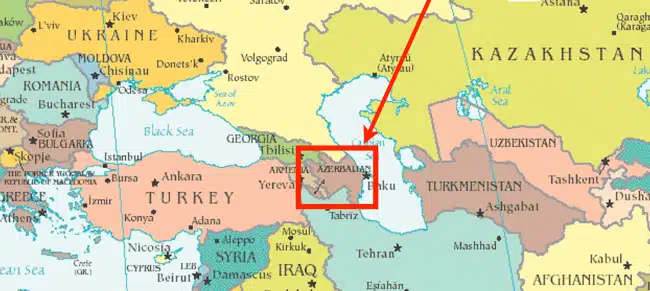
A country of more than nine million people, Azerbaijan sits at the crossroads of Eastern Europe and Western Asia. It is bordered immediately by Turkey, Iran, and Russia, and shares the region with other former Soviet republics, including Georgia and Kazakhstan.
In the first of two feature video segments below, Nicolas Tzenios introduces us to the current context of Azerbaijan, including established state supports for study abroad and trends in international enrolment within Azerbaijani institutions.
Mr Tzenios estimates that roughly 5,000 foreigners are enrolled in Azerbaijan today from as many as 30 to 40 countries. Many of these students come from Iran and Turkey and pursue their studies in the context of intergovernmental agreements.
He notes as well that Azerbaijani universities have offered English-taught programmes since the early 1990s and that this has been an important factor in the growth of inbound mobility to the country. After a period of extensive investment in programmes and infrastructure, and with the additional internationalisation of higher education an explicit priority for the government, Azerbaijan’s universities are now looking to further expand their international student numbers.
As Mr Tzenios points out, Azerbaijani study abroad has been partly underwritten in recent years by a national scholarship programme: "The state programme on the education of Azerbaijani youths in foreign countries in 2007-15." The latest reports indicate that 3,185 Azerbaijani students have been supported by the programme to date. It is due to be replaced later this year by a new scholarship programme for the period 2015-20, but details have yet to be announced.
More broadly, UNESCO estimates that just over 22,000 Azerbaijani students studied abroad in 2012, with the vast majority going to neighbouring states. Nearly half (10,530) went to Russia, and another 6,989 to Turkey and 860 to Georgia. All told, those top destinations accounted for 83.5% of Azerbaijani enrolment abroad that year. The UK (638) and Germany (580) were the only countries outside the region to rank among the five most-popular destinations.
In our second and final interview segment below, Mr Tzenios expands on the close educational and cultural links between Azerbaijan and these top host countries.
As Mr Tzenios also notes, institutions in the country are interested in expanding their links with institutions abroad. Azerbaijan has committed itself to building on the economic success of the last two decades by making a further transition to a more knowledge-based economy.
The current national development strategy - "Azerbaijan 2020: Outlook for the Future" - sets out clear priorities in this respect. It calls for a continuing increase in education funding to reach levels comparable to developed countries.
Azerbaijan became a Bologna Process signatory in 2005, and the "Azerbaijan 2020" strategy also aims to build on this in stating, "Along with the unification of education standards and deepening of the Bologna Process, attention will be paid to the expansion of the international relations of Azerbaijani institutions of education, especially institutions of higher education, and the creation of appropriate conditions for their active involvement in international programmes being implemented in the sphere of education."
Azerbaijan’s willingness and ability to invest in education, and the continuing expansion of educational programmes and participation that will result, point to opportunities for new partnerships to build and deliver programmes in-country. This potential, along with Azerbaijan’s importance as an emerging market in the region for international recruitment, will mean that the country will factor more prominently in international education in the decade ahead.