
91ɬÂþ

Market intelligence for international student recruitment from ICEF

91ɬÂþ

17th Feb 2017

Montreal tops global list of student cities

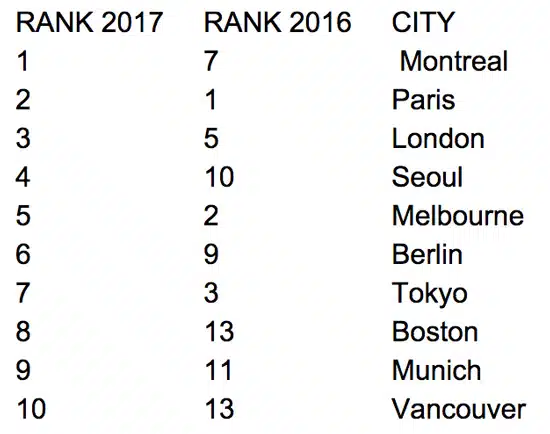
The latest ranking of study destinations scores 125 cities around the world according to the ranking of their higher education institutions, attractiveness to international students, affordability, and employer recruiting. The QS Best Student Cities 2017 showcases some significant gains and drops across the ranking table, which in turn point to underlying demand factors such as affordability and shifting currency values. Montreal tops the ranking this year, moving up six spots from 2016, and taking over from Paris, which was the top-ranked city destination for the last four years. Remarking on Montreal’s spot at the top of the ranking table, Concordia University President  said, "Canada’s education lure is no mystery. Our universities do well in international rankings. We have the lowest cost of living and highest quality of life among G7 countries." Indeed, that combination of affordability, quality of education, and student experience seem to have been the driving factors behind Canada’s strong performance in the 2017 ranking: four of the five Canadian cities included in the table moved up this year, and Ottawa took the top spot worldwide in the new "Student View" category. Student View is a new student survey factor in the QS ranking that measures students’ ratings of their city in eight categories: tolerance and inclusion, diversity, friendliness, ease of getting around, affordability, nightlife, employment opportunities, and arts and culture. Paris moves down to the second position this year, and is followed by London which moves up two places for 2017. Overall, six of the eight UK cities in the table rose in the rankings this year. the-top-ten-destinations-as-ranked-in-the-qs-best-student-cities-2017-with-the-2016-ranking-for-each-indicated-as-well The top ten destinations as ranked in the QS Best Student Cities 2017, with the 2016 ranking for each indicated as well. Source: QS A related news item in  adds that this suggests "the country is holding its place against international rivals despite negative projections in the wake of Brexit. Eight British cities made the top 50 this year - with Edinburgh rising to from 33rd to 18th place, and Manchester moving up 13 places to 23rd." Analysts attribute most of those gains to improved affordability scores for British cities across the board, owing to a post-Brexit weakening of the pound against the US dollar and other major currencies. On the other side of that coin, poorer scores for affordability led most US cities to fall down the table. Ten of the twelve included American cities dropped down the ranking this year, leaving only one - Boston - among the top ten. Similarly, all seven ranked cities in Australia fell down the table this year, with Sydney going from fourth to thirteenth, and Melbourne - the country’s lone top ten entrant - falling from second to fifth. "All Australian cities on the ranking dropped in position primarily due to poorer performance on its affordability indicator," said . Noting that Melbourne’s ranking was particularly affected by "soaring rents and accommodation costs." QS notes, however, that Australian destinations continue to score high on its “Desirability” ranking factor, a measure that reflects global indexes for liveability and safety, as well attractiveness to international students. All told, the QS ranking rolls up scores from six ranking factors to arrive at a combined score for each of the 125 cities in the table.
  • University Rankings: Reflects the performance of a city’s universities based on their placement in the QS World University Rankings.
  • Student Mix: Indicates the size and composition of the student body in each city.
  • Desirability: A more complex factor that weighs a city’s scores across a number of liveability indices, and also incorporates student input regarding the relative attractiveness of city destinations.
  • Employer Activity: Reflects the priority that employers place on a city and its institutions in terms of employee recruiting.
  • Affordability: Reflects both tuition and living costs.
  • Student View: An online survey of 18,000 students in which respondents were asked to rate their city across several lifestyle and student experience factors.

For more on destination attractiveness and affordability, please see:

Most Recent

  • Australia: Decline in international higher education commencements projected for 2026 Read More
  • The outlook for Indian student mobility through 2030 Read More
  • Well-being and pastoral care in TNE: Supporting students to thrive across borders Read More

Most Popular

  • Which countries will contribute the most to global student mobility in 2030? Read More
  • Research shows link between study abroad and poverty alleviation  Read More
  • Beyond the Big Four: How demand for study abroad is shifting to destinations in Asia and Europe Read More

Because you found this article interesting

Australia: Decline in international higher education commencements projected for 2026 Australian universities should not expect an increase in foreign students on their campuses anytime soon, according to Keri...
Read more
The outlook for Indian student mobility through 2030 A new report from QS highlights how Indian demand for study abroad is expected to continue to shift...
Read more
Well-being and pastoral care in TNE: Supporting students to thrive across borders In my previous articles, I have explored why student support must sit at the heart of successful transnational...
Read more
US government warns universities to limit their authorisation of Curricular Practical Training work placements The Trump administration continues to signal its intent to restrict international students’ work opportunities in the United States....
Read more
US Department of State issued 23% fewer study visas to international students in 2025 US Department of State data shows a dramatic -23% reduction in the number of new F-1, M-1, and...
Read more
Recruiting under Canada’s international student cap: Six strategic enrolment gaps that matter Recruitment teams across Canada are working harder than they have in years and still missing their targets. The...
Read more
91ɬÂþPodcast: Beyond the brochure: What employability really looks like for students Listen in as ICEF’s Craig Riggs and Martijn van de Veen recap some of the latest developments in...
Read more
Taiwan’s international enrolment up by 17% in 2025/26 Taiwan’s foreign enrolment grew to 140,420 in 2025/26 – a +17% increase from the previous year and an...
Read more
What are you looking for?
Quick Links


