
91ɬ

Market intelligence for international student recruitment from ICEF

91ɬ

18th Apr 2018

Study tracks the increasing popularity of alternate credentials

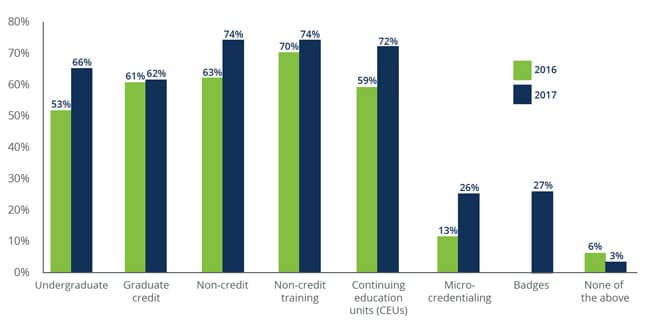
One in four higher education institutions in North America now offer badges and three in four say that such alternate credentials are “strategically important to their future.” These are some of the headline findings of  from Pearson and . The study tracks the growing footprint of alternative credentials – which are defined as “something other than the associate, bachelor’s, master’s, and doctoral degree” – in the professional, continuing, and online education offerings of North American universities and colleges. “Perhaps it’s time to see if there are different ways to prepare contemporary students for an increasingly complex knowledge and information economy, using methods that take less time, cost less money, and lead more directly to quality employment,” says UPCEA President Wayne Smutz. “At least some employers are beginning to think this might be the case, as they express frustration over not being able to find qualified employees for their vacant jobs. It is this possibility to improve the way we prepare students that drives the increasing exploration of alternative credentials, such as certificates [and] badges.” As the definition above suggests, the study takes a broad view of alternative credentials to include so-called “stackable degrees” (i.e., certificate programmes within full degree offerings that can be laddered to degree completion), shorter-term “micro-credentials” (which may or may not be stackable toward a certificate or degree qualification), and badges. The latter is the trickiest of the bunch as it can be understood in a couple of different ways including to refer to “a specific, small-grain size of work-related skill or micro-credential.” However, the term can also be used to describe a standardised digital or data-based representation of a variety of alternate credentials. As the following chart reflects, the percentage of UPCEA members offering alternate credentials across this spectrum has increased notably from just 2016 to 2017. Please note that in this context the terms “undergraduate” and “graduate credit” refer to stackable credentials within those levels of degree studies offered by responding institutions. percentage-of-upcea survey-respondents-offering-various-types-of-alternate-credentials-2016-2017 Percentage of UPCEA/Pearson survey respondents offering various types of alternate credentials, 2016 and 2017. Source: UPCEA “Non-credit certificate programmes and non-credit training courses and programmes demonstrated substantial increases and currently are the two most popular offerings, both at 74%,” notes the report. “These programme formats are likely the most popular because of their versatility and ability to adapt quickly in response to changes in skill gaps. Offered separate from traditional degree programmes, their topical coverage, focus and coursework can change based on employer and labor market demand.” The UPCEA/Pearson survey finds that badges are less commonly offered – that is, relative to stackable credentials and certificates – but are nevertheless becoming more common over the past few years, particularly in the business, healthcare, manufacturing, tourism, and technology sectors. The report adds that, “In the past year major employers have adopted digital badges for employment qualifications, including Microsoft, IBM, Oracle, Cisco and many others in the IT industry, PMI, EY and AICPA in business and professional services, and many healthcare, finance and other business sectors. The business world is increasingly embracing alternative credentials and digital badging for professional development.”
Strategically important

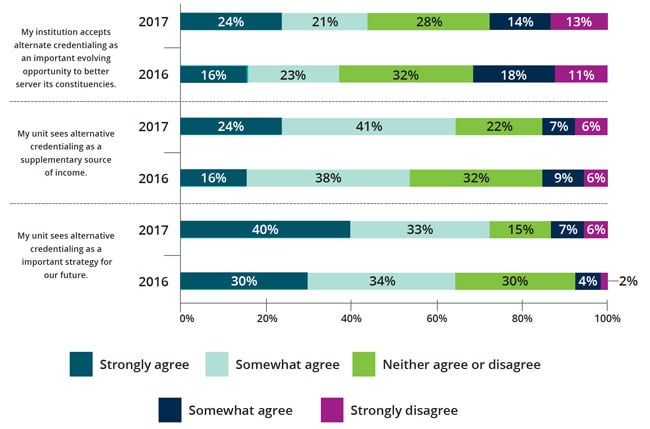
The following chart maps institutional perspectives around alternate credentials over the 2016 and 2017 survey years. Most significantly, it reflects a growing awareness of the relevance of alternate credentials to students and employers alike and, by extension, to the long-term position of the reporting institutions. institutional-perceptions-of-alternate-credentials-2016-2017 Institutional perceptions of alternate credentials, 2016 and 2017. Source: UPCEA For additional background, please see:
Most Recent

  • Australia: Decline in international higher education commencements projected for 2026 Read More
  • The outlook for Indian student mobility through 2030 Read More
  • Well-being and pastoral care in TNE: Supporting students to thrive across borders Read More

Most Popular

  • Which countries will contribute the most to global student mobility in 2030? Read More
  • Research shows link between study abroad and poverty alleviation  Read More
  • Beyond the Big Four: How demand for study abroad is shifting to destinations in Asia and Europe Read More

Because you found this article interesting

Australia: Decline in international higher education commencements projected for 2026 Australian universities should not expect an increase in foreign students on their campuses anytime soon, according to Keri...
Read more
The outlook for Indian student mobility through 2030 A new report from QS highlights how Indian demand for study abroad is expected to continue to shift...
Read more
Well-being and pastoral care in TNE: Supporting students to thrive across borders In my previous articles, I have explored why student support must sit at the heart of successful transnational...
Read more
US government warns universities to limit their authorisation of Curricular Practical Training work placements The Trump administration continues to signal its intent to restrict international students’ work opportunities in the United States....
Read more
US Department of State issued 23% fewer study visas to international students in 2025 US Department of State data shows a dramatic -23% reduction in the number of new F-1, M-1, and...
Read more
Recruiting under Canada’s international student cap: Six strategic enrolment gaps that matter Recruitment teams across Canada are working harder than they have in years and still missing their targets. The...
Read more
91ɬPodcast: Beyond the brochure: What employability really looks like for students Listen in as ICEF’s Craig Riggs and Martijn van de Veen recap some of the latest developments in...
Read more
Taiwan’s international enrolment up by 17% in 2025/26 Taiwan’s foreign enrolment grew to 140,420 in 2025/26 – a +17% increase from the previous year and an...
Read more
What are you looking for?
Quick Links


