
Let them talk: The power of student reviews

When planning a vacation, how do you choose where to go and where to stay? Chances are, you consult online reviews and recommendations posted by other travellers. Reviews likely influence your purchase decisions in other areas, too; a recent global found that online reviews are the most-searched-for source of information about products or services (55%), ahead of company websites (47%) and speaking with friends or family (23%).
International students – social media enthusiasts who spend hours of their time on the Internet – are highly influenced by online peer reviews of schools and destinations, especially when the destination is far away and they can’t visit before enrolling. They are well aware that institutional websites tend to showcase only positive testimonials, and so they often turn to third-party school selection and review websites such as CourseFinders, Go Overseas, Student Hut, and Hotcourses Abroad. These websites post both positive and negative reviews about schools and universities.
Their existence, and their popularity, has profound implications for educators. Some of the most successful schools today encourage their students to post reviews on these third-party sites.
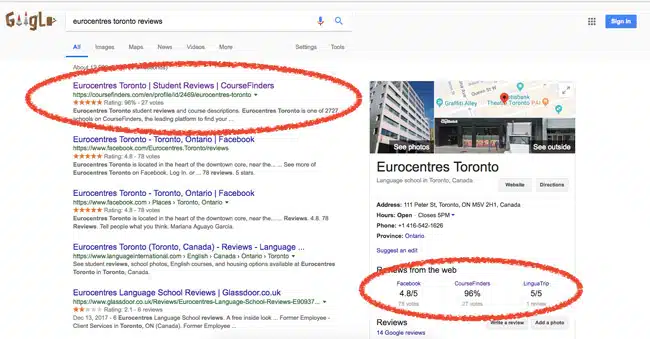
Take the bad with the good
The rise of online review culture has prompted a trend toward so-called “naked” or “transparent” marketing, whereby savvy brands accept, embrace, and respond respectfully to what their customers say about them. Consumers consider a brand to be transparent when they believe that it is ethical and honest about both positive and negative elements of its products, services, and operations. Furthermore, their trust in the brand grows if the brand acts quickly and meaningfully to address consumer feedback. Adrienne Weissman, CMO at G2 Crowd, a peer-to-peer business review platform, says that the key to naked marketing is to “have a good product, deliver killer customer service, and showcase how all of what your customers think of you." Ross Holmes, CEO of CourseFinders, agrees, noting that research shows that consumers trust the reviews attached to a brand more if there are both good and poor reviews. “It demonstrates that the company isn’t hiding anything. If people see only positive reviews, they become suspicious, and many of them will search elsewhere on the Internet to look for other opinions.” The fear of students posting critical opinions can make schools and universities nervous to engage in review culture, says Mr Holmes. But avoiding it is a mistake, he believes. “No one can make everyone happy all the time, and students know this,” he says. “In our experience, students care more about how complaints are dealt with than they do about the content of the complaint. Replying to reviews is a great opportunity for schools to show that they listen, care, and that they’re human.” “The thing to do – assuming you’re running a good school of course – is to encourage reviews by building this element into an existing system, for example, adding it as a component of the evaluation that students already fill out at the end of their studies.” The goal is to have a critical mass of student reviews posted on third party sites. Research shows that the vast majority of consumers before they feel they can trust a business, which makes the case for encouraging as many reviews as possible about your school or university. Mr Holmes notes that satisfied students often pen lengthy reviews detailing what made it so great. Other students will write about both the best parts of their time at a school and the parts that they weren’t happy with, which is actually an excellent opportunity. “That’s when you can really engage in the conversation. Listen to students’ feedback and respond promptly, because they expect an almost immediate response. Acknowledge their complaint and, if appropriate, outline what action you have taken or will take to address it. Negative comments in reviews help you spot areas of your business that need attention, and your reply helps differentiate you from your competition.”
Authenticity matters
Both the quantity and the quality of reviews impact whether or not students trust what they’re reading. For example, a school that has dozens of reviews looks more impressive than one with none. In terms of quality, the trustworthiness of a review has been shown to go up when it contains the following: linguistic fidelity (e.g., the way students really talk, so not overly formal), replies from other people and the brand itself, and the face of the reviewer.
Encouraging reviews is good marketing
Study after study shows that encouraging reviews, and not being afraid of the odd bad one, should now be an essential part of business strategy. Here are a few facts to prove the point:
- 92% of consumers now read online reviews
- Only 9% say they never search for a business online
- 48% will visit a company’s website after reading positive reviews
- 95% suspect censorship or faked reviews if they don’t see bad scores
- 68% trust reviews more when they see both good and bad scores
- 58% said they have recently begun leaving more and more online reviews based on customer service
And finally: Reviews produce an average of 18% uplift in sales. The potential is amazing, so if you haven’t already asked students to post reviews of their experience at your school or university, it’s a great time to start. For additional background, please see:
- “Student testimonials are an untapped source of competitive advantage in recruitment marketing”
- “Study finds lots of room to improve in international alumni relations”
- “Global survey highlights the importance of peer review and detailed insights for prospective students”
- “Everybody’s doing it: social proof and recruitment marketing”







