
91ɬÂþ

Market intelligence for international student recruitment from ICEF

91ɬÂþ

18th Jul 2018

Adapting student advising to boost retention and degree completion

A new survey has found that one in four undergraduate students enrolled at US colleges believe that it will be difficult for them to graduate, with anxiety and time management concerns cited as the biggest barriers. Nearly a third (30%) of Gen Z respondents cited study skills as one of the biggest obstacles to degree completion, whereas only 22% of Millennial students reported this as their top challenge. In a similar variation, 35% of Millennials said that being “overwhelmed by responsibilities” (e.g., balancing study and work, managing finances, academic planning, finding support) was one of their biggest barriers to degree completion. Meanwhile, only a quarter of Gen Z students said that managing such diverse responsibilities was their main challenge. Moreover, despite three-quarters of respondents saying that their academic advisor is the most important resource for helping them to make college decisions, less than half (48%) had met with their advisor over the past month and 24% hadn’t had a meeting for six months or longer. The survey was conducted with over 1,500 undergraduate students by Civitas Learning in collaboration with The Center for Generational Kinetics. The newly released study report is the first in a series of findings to be published from the survey.

Academic advising needs to evolve

The vast majority of students responding to the survey ranked an academic advisor as more important than other staff, family, or friends to help them make decisions, and fully 70% said that “about once a month” would be the ideal frequency for meetings. Yet as mentioned above, less than half were consulting with advisors that often. The survey asked students for their wishlist for a “more meaningful relationship” with their advisor – which might make them more likely to consult the advisor more often – and the top-ranked wishes were for:

  • Advisors to be more knowledgeable about the college, professors and culture (30%)
  • Advisors to know the students’ current situation better (30%)
  • Advisors to proactively reach out the them (27%)
  • Advisors to be more available to meet (27%)

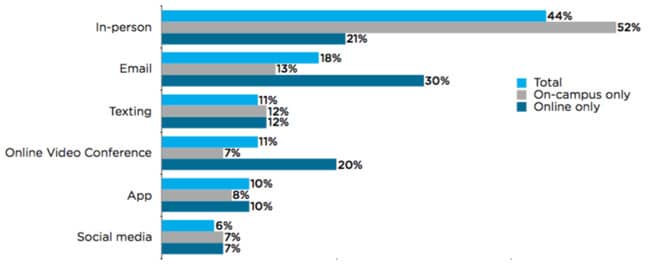
Related to the last item, close to one in five students said that when they had an urgent issue, it was difficult or very difficult to meet with an advisor. The survey findings also suggest that making a wider range of modes of advising available would increase the extent to which students could find help for their challenges. While 44% said that one-on-one personal meeting with an advisor would be their preference, significant proportions also said that emailing their advisor when they needed advice would be helpful (18%), and 11% said the same of being able to text their advisor or being able to have a one-on-one video conference. Students’ preferred ways to receive academic advising services. Source: Civitas Learning "The next wave of student success initiatives must grapple with an inescapable reality: today's students are as likely to be derailed by life and logistical challenges—balancing working and learning, childcare, food and shelter—as they are by academics," said Civitas Learning Chief Learning Officer Dr. Mark David Milliron. "If we want more students to succeed, we need to continue listening and develop systems, strategies, and messaging that is more responsive to their needs." As this point makes clear, the implications of the survey extend well beyond the US to touch any institutions that are considering how to strengthen student retention and graduation rates. The starting point, the findings suggest, is a more proactive and flexible approach to academic advising that reaches across a wider range of communication channels to reach students where and when they need support. For additional background, please see:
Most Recent

  • Australia: Decline in international higher education commencements projected for 2026 Read More
  • The outlook for Indian student mobility through 2030 Read More
  • Well-being and pastoral care in TNE: Supporting students to thrive across borders Read More

Most Popular

  • Which countries will contribute the most to global student mobility in 2030? Read More
  • Research shows link between study abroad and poverty alleviation  Read More
  • Beyond the Big Four: How demand for study abroad is shifting to destinations in Asia and Europe Read More

Because you found this article interesting

Australia: Decline in international higher education commencements projected for 2026 Australian universities should not expect an increase in foreign students on their campuses anytime soon, according to Keri...
Read more
The outlook for Indian student mobility through 2030 A new report from QS highlights how Indian demand for study abroad is expected to continue to shift...
Read more
Well-being and pastoral care in TNE: Supporting students to thrive across borders In my previous articles, I have explored why student support must sit at the heart of successful transnational...
Read more
US government warns universities to limit their authorisation of Curricular Practical Training work placements The Trump administration continues to signal its intent to restrict international students’ work opportunities in the United States....
Read more
US Department of State issued 23% fewer study visas to international students in 2025 US Department of State data shows a dramatic -23% reduction in the number of new F-1, M-1, and...
Read more
Recruiting under Canada’s international student cap: Six strategic enrolment gaps that matter Recruitment teams across Canada are working harder than they have in years and still missing their targets. The...
Read more
91ɬÂþPodcast: Beyond the brochure: What employability really looks like for students Listen in as ICEF’s Craig Riggs and Martijn van de Veen recap some of the latest developments in...
Read more
Taiwan’s international enrolment up by 17% in 2025/26 Taiwan’s foreign enrolment grew to 140,420 in 2025/26 – a +17% increase from the previous year and an...
Read more
What are you looking for?
Quick Links


