
91ɬ

Market intelligence for international student recruitment from ICEF

91ɬ

25th Jul 2018

Further private college closures predicted in US

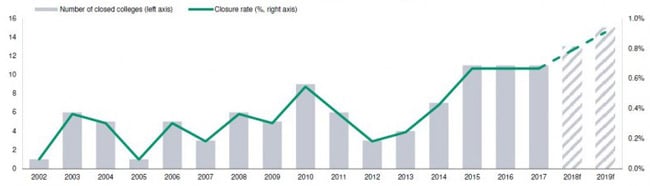
In 2015, Moody’s Investors Service famously predicted that the number of small US colleges that would close annually would triple by 2017. In the analysts’ frame of reference, “small” describes a private institution with annual revenues of under US$100 million, or a public institution with revenues below US$200 million. At the time that it published this earlier analysis in 2015, about five small US colleges were closing each year. The expectation, therefore, was that that number would spike up to roughly 15 colleges per year as of about a year ago. An updated analysis published this week (subscription required) reveals that this dramatic increase in closures has not yet come to pass, with an emphasis on the “yet”. The number of college closures in the US, however, continues to trend upward and Moody’s still expects that the number of institutions forced to wind up operations will reach up to 15 per year as of 2019 or 2020. As the following chart reflects, the number of closures will hover between 10 and 12 institutions per year for 2017 and 2018, and is expected to continue climbing through 2019. number-of-small-us-colleges-closed-per-year-and-closure-rate-as-a-percentage-of-the-total-number-of-private-not-for-profit-colleges-in-the-us-2002–2019 Number of small US colleges closed per year and closure rate as a percentage of the total number of private, not-for-profit colleges in the US, 2002–2019. Source: Moody’s At issue are the prevailing demographic and labour market trends in the US that have left many smaller colleges grappling with rising costs, declining public funding, and lower enrolments and tuition revenues. “The recession may be over, but with middle-class incomes remaining stagnant and politicians talking endlessly about the needs of the work force, liberal-arts colleges find themselves operating in a marketplace much different from that of 10 years ago,” said The Chronicle of Higher Education in 2016. “Their small size, their comparatively high cost, and sometimes even their traditional pitches about the lifelong value of a liberal-arts education work against them now, making their situation even more precarious than that of many larger institutions. Small colleges are discovering — some faster than others — that they have to be acutely sensitive to the evolving whims of students and the concerns of parents, as well as nimble enough to meet the marketplace on its terms.”
Confidence falling among finance executives

In a related development,  finds a growing financial pressure facing private colleges in particular, and a corresponding decline in the confidence of the executive financial admin staff at US institutions. Responding to this year’s survey, just under half (44%) of the chief financial officers at four-year undergraduate colleges say they are confident of their institution’s financial stability over the next ten years. This is down from 52% in 2017, and 54% in 2016. Reflecting a growing gap between costs and tuition revenues that was also observed by Moody’s, more than two-thirds of the 2018 survey respondents (68%) acknowledged that their tuition discount rates are no longer sustainable. This compares to the 59% of responding financial officers who said the same in 2017’s survey. In response, most US colleges are indicating that they will reduce tuition discount rates, expand enrolment, and introduce new “revenue-generating programmes” – as opposed to eliminating underperforming programmes or other cost-cutting measures. For many colleges, any such initiatives to build enrolment will largely focus on full fee-paying students, including those from overseas. Even so, the resilience and adaptability of smaller US colleges will continue to be tested in the years ahead. The overall context for US higher education is one of declining total enrolment with a net decrease (from a recent-year high in 2012) of more than 800,000 students through 2016. For additional background, please see:

Most Recent

  • Australia: Decline in international higher education commencements projected for 2026 Read More
  • The outlook for Indian student mobility through 2030 Read More
  • Well-being and pastoral care in TNE: Supporting students to thrive across borders Read More

Most Popular

  • Which countries will contribute the most to global student mobility in 2030? Read More
  • Research shows link between study abroad and poverty alleviation  Read More
  • Beyond the Big Four: How demand for study abroad is shifting to destinations in Asia and Europe Read More

Because you found this article interesting

Australia: Decline in international higher education commencements projected for 2026 Australian universities should not expect an increase in foreign students on their campuses anytime soon, according to Keri...
Read more
The outlook for Indian student mobility through 2030 A new report from QS highlights how Indian demand for study abroad is expected to continue to shift...
Read more
Well-being and pastoral care in TNE: Supporting students to thrive across borders In my previous articles, I have explored why student support must sit at the heart of successful transnational...
Read more
US government warns universities to limit their authorisation of Curricular Practical Training work placements The Trump administration continues to signal its intent to restrict international students’ work opportunities in the United States....
Read more
US Department of State issued 23% fewer study visas to international students in 2025 US Department of State data shows a dramatic -23% reduction in the number of new F-1, M-1, and...
Read more
Recruiting under Canada’s international student cap: Six strategic enrolment gaps that matter Recruitment teams across Canada are working harder than they have in years and still missing their targets. The...
Read more
91ɬPodcast: Beyond the brochure: What employability really looks like for students Listen in as ICEF’s Craig Riggs and Martijn van de Veen recap some of the latest developments in...
Read more
Taiwan’s international enrolment up by 17% in 2025/26 Taiwan’s foreign enrolment grew to 140,420 in 2025/26 – a +17% increase from the previous year and an...
Read more
What are you looking for?
Quick Links


