
91ɬÂþ

Market intelligence for international student recruitment from ICEF

91ɬÂþ

22nd Aug 2018

Canadian language programmes hit double-digit growth

The latest data release from Languages Canada reveals strong growth in language enrolments for 2017. In line with the broader surge in foreign enrolment in Canada last year, the country’s language training providers are reporting 10.3% growth in student numbers between 2016 and 2017. As always, the caution that applies to this data set is that the Languages Canada membership does not reflect the entire field of language programmes in the country. The association estimates that its members, and the enrolment values they report, represent roughly 80% of the Canadian market. With that qualifier in mind, the survey data from 217 member programmes indicates there were 149,379 students enrolled in language studies in 2017, up from 135,425 the year before. Adjusting for minor year-to-year fluctuations in membership, the growth rate over the two years was closer to 12% when tallying enrolments for the base of programmes that were Languages Canada members in both 2016 and 2017. This is a marked change indeed from the marginal growth that members reported in the same survey last year, and the most significant growth recorded in the annual survey for some years. Against those enrolment levels, the total volume of student weeks also increased from 1,501,083 in 2016 to 1,610,495 last year – a gain of just over 7%. Reflecting the differing pace of growth between head count and student weeks, the average length of study declined marginally in 2017, down to 10.8 weeks from 11.1 in 2016. This shift was driven in part, however, by an increasing proportion of junior bookings, which grew from 12,632 in 2016 to 16,153 last year (an increase of 28%).

Key sending markets

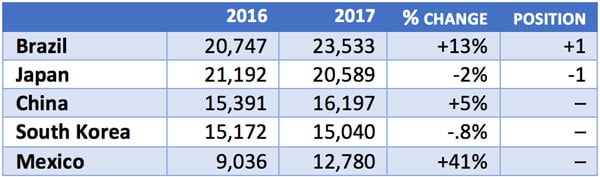
The top five source countries for Canadian language programmes in 2017 were: Brazil (23,533), Japan (20,589), China (16,197), South Korea (15,040), and Mexico (12,780). As the following table reflects, this grouping is consistent from 2016. However, Brazil moved ahead of Japan last year to take up the number one spot, with Brazil and Mexico the big gainers among the top sending markets in 2017. This pattern reflects both the continuing strong popularity of Canada as a study destination for Brazilian language students over the last three years. At the same time, the current political context in the US appears to have also contributed to a spike in the already-strong interest in studying in Canada among Mexican language students. Top five sending markets for Canadian language programmes, 2016 and 2017. Source: Languages Canada Along with Mexico’s 41% growth in student numbers from 2016 to 2017, Vietnam was the fastest-growing source country last year with a 203% increase. As in other major receiving markets, the volume of Saudi Arabian students continued its sharp decline last year, from a height of more than 15,000 in 2012 to only 3,834 in 2017 (a 36% decline from 2016). “There has been a lot of promotion going on,” says Languages Canada Executive Director Gonzalo Peralta in reflecting on the growth in 2017. “But what we are really seeing is the principle of alignment at work. When the collective efforts of institutions and schools, representative associations, and governments are all aligned, then everything works.” Looking specifically at the strong performance in 2017 for the Mexican and Vietnamese markets, Mr Peralta feels that a greater alignment of government policy with the recruiting efforts of Canadian institutions has been the major factor. “Policy is responsible,” he says. “Specifically the great work that [Immigration, Refugees and Citizenship Canada] has done.” These initiatives include the now-expanded pilots in Vietnam (and other selected Asian markets) to streamline and speed student visa processing. And they also include an easing of visa requirements for Mexican students first announced in 2016. In terms of future market development, Languages Canada members identify China, Brazil, Mexico, Vietnam, Colombia, and Turkey as their top priorities for marketing and recruitment.
A considerable impact

The association estimates that direct spending by language students in Canada amounted to CDN$1.6 billion in export revenues in 2017 (US$1.2 billion). Reflecting overall enrolment gains over the two years, this is up by just over 11% from 2016 levels. That estimate, however, excludes the knock-on effects of students carrying on to further studies after their language programmes. This is a significant aspect of additional economic impact in that the survey data indicates that roughly a third of all language students in Canada intend to carry on to post-secondary studies after building their language skills. For additional background, please see:

Most Recent

  • Australia: Decline in international higher education commencements projected for 2026 Read More
  • The outlook for Indian student mobility through 2030 Read More
  • Well-being and pastoral care in TNE: Supporting students to thrive across borders Read More

Most Popular

  • Which countries will contribute the most to global student mobility in 2030? Read More
  • Research shows link between study abroad and poverty alleviation  Read More
  • Beyond the Big Four: How demand for study abroad is shifting to destinations in Asia and Europe Read More

Because you found this article interesting

Australia: Decline in international higher education commencements projected for 2026 Australian universities should not expect an increase in foreign students on their campuses anytime soon, according to Keri...
Read more
The outlook for Indian student mobility through 2030 A new report from QS highlights how Indian demand for study abroad is expected to continue to shift...
Read more
US government warns universities to limit their authorisation of Curricular Practical Training work placements The Trump administration continues to signal its intent to restrict international students’ work opportunities in the United States....
Read more
US Department of State issued 23% fewer study visas to international students in 2025 US Department of State data shows a dramatic -23% reduction in the number of new F-1, M-1, and...
Read more
Recruiting under Canada’s international student cap: Six strategic enrolment gaps that matter Recruitment teams across Canada are working harder than they have in years and still missing their targets. The...
Read more
Taiwan’s international enrolment up by 17% in 2025/26 Taiwan’s foreign enrolment grew to 140,420 in 2025/26 – a +17% increase from the previous year and an...
Read more
The questions families are actually asking: Inside the student advising conversation in 2026 Five years ago, a typical counselling session began with a list. A student would come in with the...
Read more
US coalition files lawsuit to challenge rule ending Duration of Status admissions for international students A consortium of prominent education organisations and unions has announced that it has mounted a legal challenge to...
Read more
What are you looking for?
Quick Links


