
New Zealand opens up post-study work rights

After a consultation period marked by more than 2,000 submissions from stakeholders, the New Zealand government is moving to open up post-study work rights for international students. Formally announced on 8 August and due to come into effect on 26 November 2018, the changes will extend the post-study work terms available to many international students in New Zealand, remove employer-assisted post-study work visas, and provide additional incentives for study outside of Auckland, the country’s largest city. Speaking at the New Zealand International Education Conference () in Wellington earlier this month, Immigration Minister Iain Lees-Galloway expanded on the government’s rationale for the new policy settings. “International education is an incredibly important component of the New Zealand economy and of the New Zealand society,” said the minister. “It is currently our fifth-largest export earner, and brings significant social, cultural, and educational benefits. We want to ensure that international students coming to New Zealand are motivated by the opportunity to have a great experience and to get the very best education.” New Zealand Immigration Minister Iain Lees-Galloway’s address at the NZIEC 2018 conference in Wellington, 9 August 2018
Stay and work
The new policy provides for the following:
- A move away from employer-assisted work visas to open work visas. As a related statement from Immigration New Zealand explains, this means that for students, “Your work visa won’t be linked to any employer and the employer-assisted post-study work visa will no longer exist. You won’t need a job offer to get a post-study work visa.”
- Students studying at levels 4–6 in the will receive a one-year open work visa. As the following figure illustrates, this refers to non-degree programmes (i.e., certificates or diplomas) at the post-secondary level. This provision applies as well for those engaged in non-degree studies at Level 7 in the qualifications framework.
- Level 7 students enrolled in graduate diploma programmes leading to a professional designation will receive an open work visa for two years.
- Students engaged in degree studies at Level 7 or above – that is, undergraduate or higher – will receive a three-year open work visa.
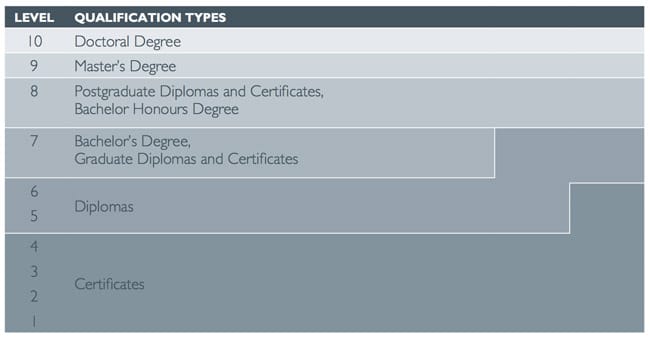
To provide a further incentive to study in regions throughout the country, Level 4–6 students (and non-degree students at Level 7) enrolled in institutions outside of Auckland will receive a two-year open work visa, providing that their programmes conclude by December 2021. The government has also introduced transition measures to support both students and institutions in moving to the new policy settings, including a detailed brief for both current and incoming students. In short, most students enrolled as of 8 August will automatically qualify for a three-year open work visa on completion of their studies. Otherwise, the net effect of the changing policy is to reduce the maximum term of the work visa for those enrolled below Level 7, and to remove the requirement for a job offer for those who are eligible to work for an extended period after their studies. Currently, Level 4–6 students can remain on a one-year open visa and then a two-year employer-assisted visa. Once the new policy is fully in effect, they will be constrained to a one-year open visa (or two years if studying outside of Auckland). For degree students at Level 7 and above, however, the new policy offers greater flexibility and reduced risk of exploitation by employers with a three-year open work visa. In his remarks at NZIEC Minister Lees-Galloway was quick to point out that graduates at all levels also have an additional option to extend their stay in New Zealand via the . International graduates on open work visas who meet the requirements of the Essential Skills programme are eligible to apply at any time and, if successful, can extend their stay in the country for up to five additional years. “What we are saying with these changes is that the pathway to residency from study is one that is based on skills,” said the minister. “Skills that are in demand here in New Zealand. So for those people who do study at below degree level there is a path to residency if that is what they are seeking. That pathway is through the Essential Skills process where they can demonstrate that they have a skill that is in demand.”
A boost for competitiveness
“I know that the work opportunities are part of the package that makes us competitive with other nations that seek to attract international students,” added Mr Lees-Galloway. “If we look at our [post-study work policy] and how they compare with our major competitors, we have in fact improved our position. [Under the new policy] we remain second only to Canada in terms of the work rights that people receive.” “Providing good graduate outcomes is key to attracting the best students from overseas,” agrees Universities New Zealand Executive Director Chris Whelan. “Though most international students return to their home countries after they graduate, a proportion have the qualifications and skills that New Zealand employers need but can’t find enough of from pool of domestic graduates. Having the option of staying in New Zealand for up to three years after graduating makes New Zealand a more attractive study destination for these international students while contributing to our businesses and economy.” For additional background, please see:







