91ɬÂþ

Market intelligence for international student recruitment from ICEF

91ɬÂþ

19th Sep 2018

Another year of growth for France

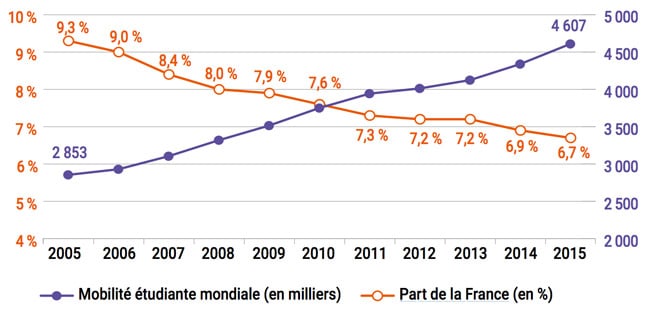
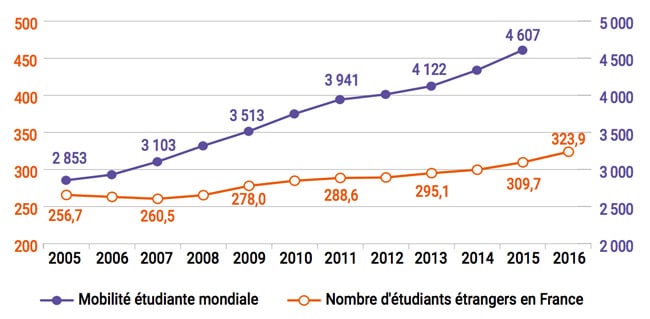
The number of international students in France continues to grow, but at a slower pace than has been the case for other major study destinations. The end result is that, even as the total number of foreign students in the country continues to increase, France is effectively ceding market share to other leading countries that are growing more quickly. As we explored in another recent post, France is now the seventh leading global study destination, after the US, UK, Australia, Canada, China, and Germany. This also places France as the third-ranked destination in Europe, and the second among non-English-speaking host countries. The most recent mobility figures, released earlier this year by , reveal that the number of international students in France grew to 323,933 in the 2016/17 academic year. This amounts to year-over-year growth of 4.6% – the country’s fastest rate of growth in five years – and an overall increase of 12.2% in total foreign enrolment since 2011/12. The two charts that follow tell the story of this growth dynamic. In the first, we see the growth in international enrolment in France since 2005 weighed against global growth in student mobility. In the second, we see the share of internationally mobile students hosted by France, again since 2005, in the context of that global growth. Growth in international enrolment in France (shown in red) in relation to overall growth in international mobility for higher education (shown in blue), 2005–2016. Source: Campus France France’s share of the global student market for higher education abroad (shown in red) relative to overall growth in international student mobility (shown in blue), 2005–2016. Source: Campus France
Africa leads among sending regions

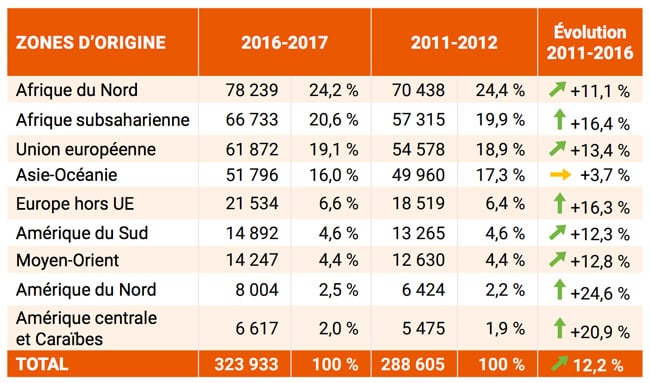
As the following table illustrates, Africa remains the primary source of foreign students for France, and accounted for nearly half (44.8%) of all visiting students in 2016/17. Students from the European Union (19%) and Asia (16%) combine for another 35% of total enrolment. In terms of absolute numbers, those three regions have also driven most of the growth for France since the early part of this decade. A breakdown of foreign enrolment in France by source region for 2016/17, with the growth each region since 2011/12 indicated as well. Source: Campus France Among sending countries, Morocco, Algeria, Tunisia, and Senegal account for the bulk of African enrolment for France – the first two of these have demonstrated consistent (and strong) growth since 2011/12 whereas both Tunisia and Senegal have declined marginally over the last five years. European growth, meanwhile, has been buoyed by a number of markets, including Italy (+54% since 2011/12), Spain (+30%), and Portugal (+39%). The United States, which ranked as the 12th leading sender for France in 2016/17, has also shown strong overall growth of 32% over the last five years.
Positioning for the future

Some of the slower growth of the past several years can be traced to the so-called “Circular Guéant” – a widely criticised policy statement from May 2011. The circular introduced new restrictions on post-study immigration that prevented some non-EU students from staying and working in France after graduation. It was repealed in 2012, but the perception of France as a less welcoming destination for students outside the EU appears to have lingered on. This effect has been reversed to some extent by the global popularity of French President Emmanuel Macron, who came to office in May 2017, and by his strong statements on the need for France to become a more welcoming and ambitious study destination. In a 20 March 2018 speech, President Macron said, “We cannot be such country anymore that imposes an ordeal to international students who want to come to study. France must increase the number of international students on its soil, and the number of students coming from emerging countries must double. Indian, Russian and Chinese students must have the greatest numbers.” Béatrice Khaiat is the general manager of Campus France and she reflected on this changing orientation in a recent interview with : "France took a lot of time to get out of Circular Guéant. By restricting the issuance of temporary residence permits, which allowed a graduate to work, this circular had an impact far beyond the people concerned, sending a negative signal on the reception in France. The trend has now reversed. And the signals sent by Emmanuel Macron over the past year will amplify the momentum.” For additional background, please see:

Most Recent

  • Australia: Decline in international higher education commencements projected for 2026 Read More
  • The outlook for Indian student mobility through 2030 Read More
  • Well-being and pastoral care in TNE: Supporting students to thrive across borders Read More

Most Popular

  • Which countries will contribute the most to global student mobility in 2030? Read More
  • Research shows link between study abroad and poverty alleviation  Read More
  • Beyond the Big Four: How demand for study abroad is shifting to destinations in Asia and Europe Read More

Because you found this article interesting

Australia: Decline in international higher education commencements projected for 2026 Australian universities should not expect an increase in foreign students on their campuses anytime soon, according to Keri...
Read more
The outlook for Indian student mobility through 2030 A new report from QS highlights how Indian demand for study abroad is expected to continue to shift...
Read more
US government warns universities to limit their authorisation of Curricular Practical Training work placements The Trump administration continues to signal its intent to restrict international students’ work opportunities in the United States....
Read more
US Department of State issued 23% fewer study visas to international students in 2025 US Department of State data shows a dramatic -23% reduction in the number of new F-1, M-1, and...
Read more
Recruiting under Canada’s international student cap: Six strategic enrolment gaps that matter Recruitment teams across Canada are working harder than they have in years and still missing their targets. The...
Read more
Taiwan’s international enrolment up by 17% in 2025/26 Taiwan’s foreign enrolment grew to 140,420 in 2025/26 – a +17% increase from the previous year and an...
Read more
The questions families are actually asking: Inside the student advising conversation in 2026 Five years ago, a typical counselling session began with a list. A student would come in with the...
Read more
US coalition files lawsuit to challenge rule ending Duration of Status admissions for international students A consortium of prominent education organisations and unions has announced that it has mounted a legal challenge to...
Read more
What are you looking for?
Quick Links