Regional demand variations taking hold in graduate business studies
For the second year in a row, a global survey is highlighting important regional shifts in application volumes for graduate studies in business.
The newly released (and 19th annual) is produced by the Graduate Management Admission Council (GMAC). This year’s edition draws on responses from 363 business schools in 44 countries for its observations on the global demand for graduate business programmes.
Overall, GMAC finds global application volumes are essentially flat this year, with a very marginal overall decline of .02% from 2017. The GMAC notes this “steady” trend at the outset of its 2018 report, and highlights as well that the vast majority of responding institutions (nine out of ten) indicate that their candidate pool is “similarly or more academically qualified” this year compared to last.
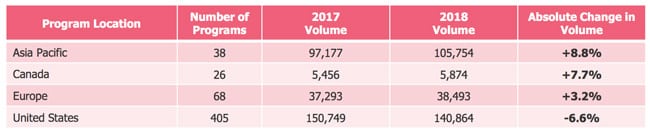
While just under half of responding schools (48%) report growing or stable application volumes for 2018, the real story in this year’s survey are the regional variations that we began to observe in 2017. Simply put, application numbers are up in all other reporting world regions, but down for US business schools. Those regional and national trends are summarised in the following table, which reports a nearly 7% decline overall for graduate business programmes in the US.
Total application volumes for graduate business studies by region, 2017 and 2018. Source: GMAC
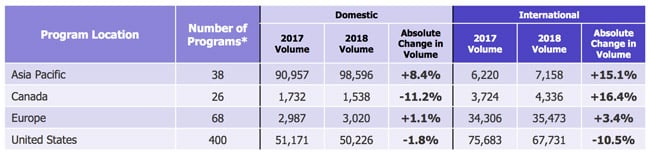
Those broad trends are more interesting still when broken down into domestic and international applicant pools, as we see in the subsequent table below. As GMAC puts it, “Application volumes to graduate business programmes in Asia Pacific, Europe, and Canada are up compared with last year, while application volumes to US programmes are down. Application increases to European and Canadian programmes are driven primarily by international demand, whereas application increases to Asia-Pacific programmes are driven primarily by domestic demand. Most programmes in the United States report declines in international applications this year, while domestic application trends are mixed across programme types.”
Domestic and international application volumes for graduate business studies, by region, 2017 and 2018. Source: GMAC
from the Poets & Quants website points out that the decline in US application numbers this year is notable as well in that it is affecting all tiers of business schools in the United States – whereas previous year declines were more concentrated among lower-ranked institutions.
In contrast, early numbers reported by Poets and Quants point to declines this year at leading US business schools, including The Wharton School at the University of Pennsylvania (-6.7% compared to 2017), Yale University’s School of Management (-7.6%), University of Michigan’s Ross School of Business (-8.5%), and Duke University’s Fuqua School of Business (-6.2%).
However, the site notes as well that, “Many of these highly selective schools have deep applicant pools and are still turning away the vast majority of those who apply to their programmes. So school officials say that this year’s drop has not had an impact on the overall quality of their latest incoming classes. And in some cases the falloff is occurring after several years of growth.”
Even with that important qualifier, the nearly 11% drop in applications to US graduate schools of business is raising eyebrows this year. The decline is accompanied by questions about the impact of the current political climate in the US, and also by anecdotal reports of more stringent visa processes.
These observations of shifting demand for graduate studies at US business schools follow other recent findings of overall declines in international student numbers in US graduate programmes across all fields of study.
For additional background, please see: