
91ɬÂþ

Market intelligence for international student recruitment from ICEF

91ɬÂþ

4th Jun 2019

US ELT numbers decline for third consecutive year

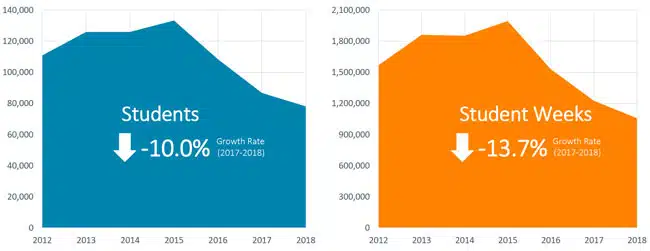
International enrolment in Intensive English Programmes in the US fell by 10% between 2017 and 2018 (and student weeks by 13.7%) according to the new data from the Institute of International Education () presented at the NAFSA conference in Washington, DC, last week. The data was collected via the IIE’s annual Intensive English Programme survey conducted among 400 IEPs (both those within higher education institutions as well as independent centres) throughout the US. In total, the survey finds that 78,100 international students studied intensive English for 1,057,650 student weeks in 2018.

Three years of decline, but decrease is less severe in 2018

The declines mark the third year of a downward trend in the US English-language training sector in the US. From a historic high point in 2015, IEP numbers in the US have declined by nearly 42% overall – and student weeks by 46% – through 2018. total-enrolment-in-us-ieps-shown-as-student-numbers-left-and-student-weeks-right-2012–2018 Total enrolment in US IEPs, shown as student numbers (left) and student weeks (right), 2012–2018. Source: IIE In her presentation at the NAFSA conference, IIE Research Specialist Julie Baer noted that the rate of decline for US IEPs slowed in 2018. She also highlighted that year-to-year IEP trends tend to be more volatile than those in higher education, in part because English-language students are not committed to multi-year programmes. As a result, any changes in political or economic conditions in sending markets tend to be felt more immediately in the form of enrolment declines or increases and also in the number of weeks that students spend in a language programme. The US data appears in a global context wherein trends for English-language training enrolments and weeks are quite mixed according to destination. For example:
  • In Ireland, international student enrolments were down by 5% in 2018 after several years of steady increases. Despite the enrolments decrease, however, student weeks spent in Ireland’s English-language training centres reached a record high in 2018.
  • In Malta, enrolments were flat in 2018 and student weeks fell by 12%. This is in contrast to the previous year’s results where there was a 15.5% increase in enrolments and a nearly 7% jump in student weeks.
  • In South Africa, enrolments fell by 5% but student weeks increased by 5% in 2018. In 2017, there had been a 15% increase in enrolments and close to a 13% jump in student weeks.
  • In the UK, 2018 was a lacklustre year for private-sector ELT centres, with enrolments growing by 1% and student weeks falling by 3%. In contrast, English-language training centres in UK colleges and universities saw enrolments jump by 10.5% and weeks grow by 11% (largely because the main sending market for these state centres, China, contributed 20% more weeks in 2018).
  • In the most recent data released by Australia’s Department of Education and Training, which spoke to mid-2018 trends as opposed to full-2018 results, ELICOS (English Language Intensive Courses for Overseas Students) were looking at . The longer-term picture, however, is that Australia has steadily gained market share since 2013.

Latin America the only growth region

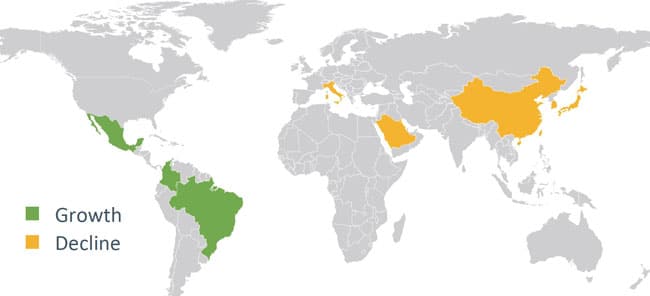
The number of Latin American and Caribbean students in US IEPs grew by 8% in 2018, but the remainder of sending regions sent fewer students. Asia sent -8% fewer students, Europe -9%, the Middle East and North Africa (MENA) -18%, and sub-Saharan Africa -21%.

Main source markets

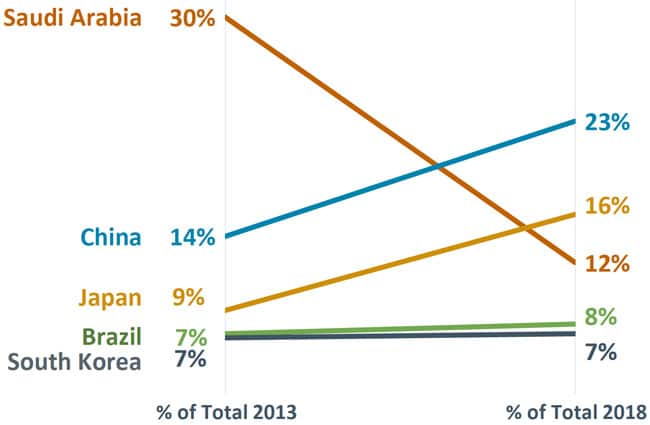
Two-thirds (66%) of students enrolled in US IEPs come from just five countries: China, Japan, Saudi Arabia, Brazil, and South Korea. The share of Saudi Arabian students studying in US IEPs has fallen from 30% five years ago to 12% in 2018 as a result of deep cuts beginning in 2015 to the King Abdullah Scholarship programme, which once funded thousands of Saudi Arabian students in the US. China’s share has moved from 14% to 23%, and Japan has also increased its contribution of students. Japanese students now make up 16% of the total compared with 9% five years ago. the-top-five-sending-markets-for-us-ieps-as-a-percentage-of-total-enrolment-2013-2018 The top five sending markets for US IEPs, as a percentage of total enrolment, 2013–2018. Source: IIE Expanding that list slightly, the top ten sending markets for US IEPS are:
  • China: 17,700
  • Japan: 12,305
  • Saudi Arabia: 9,660
  • Brazil: 6,155
  • South Korea: 5,620
  • Taiwan: 2,660
  • Mexico: 1,975
  • Colombia: 1,835
  • Kuwait: 1,835
  • Italy: 1,330

Reflecting the regional patterns we noted earlier, only the three top ten senders in Latin America demonstrated any enrolment growth last year. All other top ten sending markets declined in 2018. Enrolment growth (in green) or decline (in yellow) for the top ten sending markets for US IEPs in 2018. Source: IIE For additional background, please see:
Most Recent

  • Australia: Decline in international higher education commencements projected for 2026 Read More
  • The outlook for Indian student mobility through 2030 Read More
  • Well-being and pastoral care in TNE: Supporting students to thrive across borders Read More

Most Popular

  • Which countries will contribute the most to global student mobility in 2030? Read More
  • Research shows link between study abroad and poverty alleviation  Read More
  • Beyond the Big Four: How demand for study abroad is shifting to destinations in Asia and Europe Read More

Because you found this article interesting

Australia: Decline in international higher education commencements projected for 2026 Australian universities should not expect an increase in foreign students on their campuses anytime soon, according to Keri...
Read more
The outlook for Indian student mobility through 2030 A new report from QS highlights how Indian demand for study abroad is expected to continue to shift...
Read more
US government warns universities to limit their authorisation of Curricular Practical Training work placements The Trump administration continues to signal its intent to restrict international students’ work opportunities in the United States....
Read more
US Department of State issued 23% fewer study visas to international students in 2025 US Department of State data shows a dramatic -23% reduction in the number of new F-1, M-1, and...
Read more
Recruiting under Canada’s international student cap: Six strategic enrolment gaps that matter Recruitment teams across Canada are working harder than they have in years and still missing their targets. The...
Read more
Taiwan’s international enrolment up by 17% in 2025/26 Taiwan’s foreign enrolment grew to 140,420 in 2025/26 – a +17% increase from the previous year and an...
Read more
The questions families are actually asking: Inside the student advising conversation in 2026 Five years ago, a typical counselling session began with a list. A student would come in with the...
Read more
US coalition files lawsuit to challenge rule ending Duration of Status admissions for international students A consortium of prominent education organisations and unions has announced that it has mounted a legal challenge to...
Read more
What are you looking for?
Quick Links


