
91ɬÂþ

Market intelligence for international student recruitment from ICEF

91ɬÂþ

18th Sep 2019

Canada: Study permit rejection rates on the rise

New data released by Immigration, Refugees and Citizenship Canada (IRCC) charts a distinct increase in rejection rates for international students applying for a study permit (i.e., a study visa) for Canada.

From 2014 through 2018, total foreign enrolment in Canada grew by just over 73%, making the country the world’s fastest-growing study destination over those five years.

IRCC data supplied to Polestar Student Immigration News for year-to-date May 2019 shows that nearly four in ten applications for study permits (39%) were rejected in the first five months of this year. As the following chart reflects, this compares to a 28% rejection rate in 2014, and a 34% refusal rate in 2018.

As the chart shows, rejection rates vary by education sector, with refusal rates for those accepted to college programmes historically tracking above applicants for other sectors.
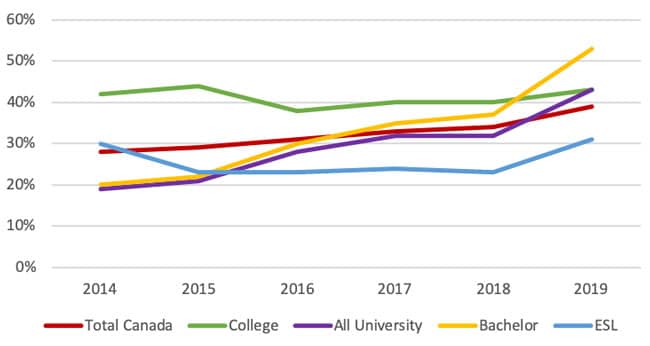
Rejection rates for Canadian study permit applications, 2014 (full year)
to 2019 (through May). Source: IRCC,
Polestar

This picture changed somewhat in 2018, however, with rejections for bachelor degree studies exceeding those for college applicants that year. As the chart below illustrates, more than half of all applicants for undergraduate studies were refused in the first five months of 2019. This compares to a 31% refusal rate for master’s studies, or 43% for college applicants.
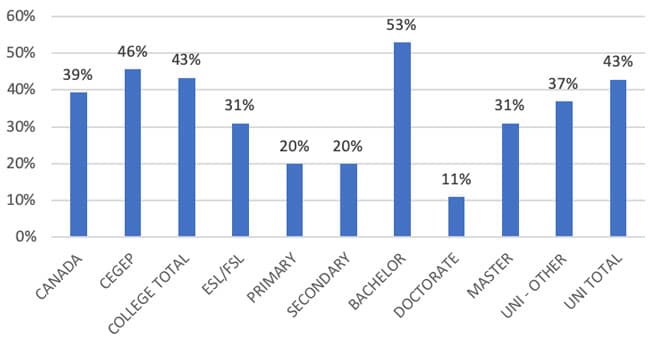
Study permit refusal rates by programme type,
year-to-date May 2019. Source: IRCC,
Polestar

A statement on the IRCC website explains that applications for study permits may be refused if the student does not:

  • “show proof that you have enough money to support yourself while studying in Canada
  • pass your medical exam, if you needed to get one
  • convince the visa officer that your main purpose in Canada is to study or
  • convince the visa officer that you’ll leave Canada at the end of your study period”

Speaking recently to AdvocateDaily.com, Toronto-based immigration lawyer Andrew Carvajal expanded on the third point above. He explains that an immigration officer may simply conclude that the applicant does not have a legitimate study plan for Canada, and may be using the study permit route as a way to quickly and legally enter the country.

"I've found more immigration officers are making that determination,” says Mr Carvajal. “Although an applicant has been accepted to a legitimate program in Canada, officials don't see those studies as legitimate. Officers have become like career counsellors, whether a programme makes sense or not. That we have seen increase.”

For additional background, please see:

Most Recent

  • Australia: Decline in international higher education commencements projected for 2026 Read More
  • The outlook for Indian student mobility through 2030 Read More
  • Well-being and pastoral care in TNE: Supporting students to thrive across borders Read More

Most Popular

  • Which countries will contribute the most to global student mobility in 2030? Read More
  • Research shows link between study abroad and poverty alleviation  Read More
  • Beyond the Big Four: How demand for study abroad is shifting to destinations in Asia and Europe Read More

Because you found this article interesting

Australia: Decline in international higher education commencements projected for 2026 Australian universities should not expect an increase in foreign students on their campuses anytime soon, according to Keri...
Read more
The outlook for Indian student mobility through 2030 A new report from QS highlights how Indian demand for study abroad is expected to continue to shift...
Read more
US government warns universities to limit their authorisation of Curricular Practical Training work placements The Trump administration continues to signal its intent to restrict international students’ work opportunities in the United States....
Read more
US Department of State issued 23% fewer study visas to international students in 2025 US Department of State data shows a dramatic -23% reduction in the number of new F-1, M-1, and...
Read more
Recruiting under Canada’s international student cap: Six strategic enrolment gaps that matter Recruitment teams across Canada are working harder than they have in years and still missing their targets. The...
Read more
Taiwan’s international enrolment up by 17% in 2025/26 Taiwan’s foreign enrolment grew to 140,420 in 2025/26 – a +17% increase from the previous year and an...
Read more
The questions families are actually asking: Inside the student advising conversation in 2026 Five years ago, a typical counselling session began with a list. A student would come in with the...
Read more
US coalition files lawsuit to challenge rule ending Duration of Status admissions for international students A consortium of prominent education organisations and unions has announced that it has mounted a legal challenge to...
Read more
What are you looking for?
Quick Links


