
Education agents refer 75% of Australia’s international students

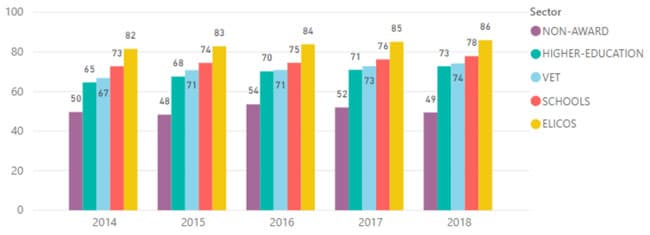
Education agents helped to secure 75% of enrolments in Australia’s schools, vocational institutes, English-language training centres (ELICOS), and universities in 2018, according to a government report on the use of agents in the country’s education system. The report is based on data from Australia’s Provider Registration and International Student Management System ().
This percentage rises when it comes to the ELICOS sector where agents enabled 86% of enrolments, similar to trends from the previous four years. Universities have increased their use of agents since 2014, with agents playing a role in 73% of enrolments in 2018 versus 65% in 2014.
Agents key in major sending markets
Students from Brazil, Colombia, and Nepal – countries that are all important emerging target markets for Australian educators – are especially likely to have been recruited through agents. More than nine in ten (92%) Brazilian students, 89% of Colombian students, and 84% of Nepalese students came into the system through agents in 2018. Brazil and Nepal are projected to be among the top source markets for Australia in 2025.
Meanwhile, students from Australia’s current leading markets – China and India – are also extensively engaged with agents. Nearly three in four (73%) Chinese students in Australia are referred by agents, as are a similar proportion (72%) of Indian students.
Large agencies send the most
There has been a 27% increase in the number of education agencies working with Australian educators since 2014 and 35% growth in that same timeframe in international enrolments. While there are thousands of agencies playing a role in recruitment, the vast majority (70%) of Australian enrolments are driven by large agencies with at least 500 employees. These larger agencies also tend to encounter lower visa rejection rates for their students, which reinforces the trend of Australian educators often choosing to work with them.
Student incompletion rates
Student incompletion rates – i.e., data that illuminates which agent-generated enrolments resulted in a termination for any of several reasons such as students not beginning their studies, withdrawing or deferring, not complying with visa rules, and more – are low for the schools and non-award sectors and higher for the VET sector.
More performance data on the way
In recognition of the prominent role that agents are playing in the Australian international education sector, the Australian government plans to publish more data on agent performance later this year.
“Education agents are playing an increasingly larger role in the international student sector, and education providers are responsible for ensuring they are using reputable agents,” said Education Minister Dan Tehan. “The publication of this data will help inform providers about how agents are performing and to use that information when making decisions about which agents to do business with. This data gives providers visibility of the enrolment and visa outcomes of students recruited by their agents, as well as benchmarking performance against other agents.”
Record numbers in 2018
The government reports that the country’s 693,750 international students were worth AUS$35.2 billion to the Australian economy and supported 240,000 jobs in 2018. International enrolments grew by 11.4% from 2017 to 2018 across all sectors, and the higher education sector experienced the most growth (14.4%).
While China remains by far the largest source country for Australia’s education exports, two other countries contributed higher rates of growth from 2017 to 2018: India grew by 24.5% to 108,290 enrolments and Nepal, the third most important sending market, contributed 52,243 enrolments – a huge 48.4% increase over 2017.
For additional background, please see:







