
Stealth applicants and the role of the institutional website

Data released earlier this year reveals that the vast majority of international students never make contact with the university, college, or school they apply to and receive offers from, and half of these students use only the university website as an information source before applying.
The data comes from enrolment services management company UniQuest, which since 2013 has managed nearly one million student files from enquiry through to enrolment. UniQuest analysed close to 16,000 offers from partner UK universities to international students – and also conducted a survey among more than 1,500 of those offer holders – to illuminate the behaviours of so-called “stealth applicants.” These applicants are those students who do not make contact with an institution before they apply, and they make up a surprisingly large segment of the total applicant base: UniQuest found that stealth applicants make up 82% of all international enrolments at its partner universities.
The data generated from the survey underlines the extent to which stealth applicants are a source of potential enrolments for universities. In 2018, 91% of students who received offers from UniQuest university partners were stealth applicants.
A quarter of stealth applicants used Google to discover their university, and again, half (52%) went only to the university website as a result of their search. By comparison, 3.5% used the university website plus rankings, and 3.5% talked only with friends before applying.
All this means that a well-designed, attractive website that highlights essential information and provides clear guidelines on how to apply is crucial for universities and schools that enrol foreign students.
Jennifer Parsons, partnerships and insights director with UniQuest, explained:
“As enquiries pre-application become less common, most universities we speak with are struggling to accurately trace the full impact of their marketing on actual enrolments. Through this study and the student data we collect daily through our end-to-end student conversion service, we can paint a more complete picture of marketing channel ROI, and we’re finding that the university website is extremely valuable.”
Data clarifies order of priorities
While it’s true that education marketers have to manage a number of recruitment channels, the UniQuest data shows than none of these is more important than the institutional website.
In an interview with 91ɬÂþMonitor, UniQuest Head of Global Marketing Mary Evans explained that, “Recruiters feel that they have to do so many things: social media, fairs, lead generation sites, etc. What this research shows is that the university website is still very important.”
She noted that the data suggests an order of priorities:
“New channels are not mutually exclusive to more traditional recruitment channels but when we look at the things that actually make a difference – that move students towards applying, for example – social channels are actually far down the list.”
Ms Evans also noted the dangers of not having the most important information on the website given how much stealth applicants are consulting it: “If, for example, they are asking questions about scholarships after application, that’s not good because perhaps they don’t have the means to self-fund their studies. Or if they are asking about deferring admissions.”
Make it as easy as possible
As much as the research reveals the key role the institutional website has, it alone cannot always do all the work required to drive enrolments. For example, UniQuest found that the offer conversion rate (i.e., the proportion of offers that turned into enrolments) was 56% lower for stealth applicants than for those that had inquired or had some contact with the institution before applying. Twelve in every 91 stealth applicants go on to enrol. In contrast, of nine prospects who enquire (i.e., contact the university for information), two to three will enrol.
In some countries, the rate of conversion is much higher for students who enquire. For example, in China, where 99% of offer holders are stealth, the conversion rate (i.e., to enrolment) is 247% higher for students who enquire; in India (94% stealth applicants), it’s 190% higher. The trend is similar in Nigeria and Malaysia.
Placing live chat cues, telephone numbers, and emails prominently, as well as links to financial aid/scholarship information, have the potential to turn a “stealth” applicant into a prospect who (1) has enough information to apply with more interest/intent, and/or (2) decides to contact the university to find out if it really might be a good fit.
Live chat is a major advantage
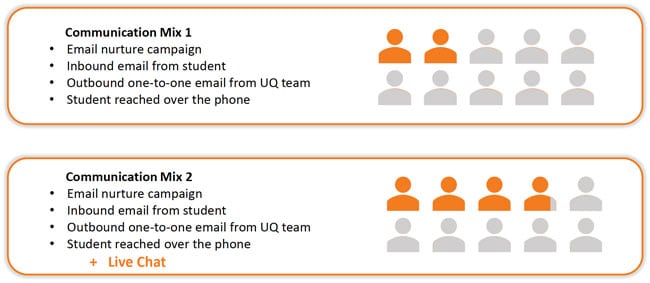
As the following slide shows, adding a live chat functionality to a communications programme can significantly boost conversion results.
UniQuest also advises institutions to track their applications in order to gain insights on their stealth and enquiring applicants and what is motivating both (or acting as a barrier). Doing so also clarifies what kind of communications programme should be initiated with stealth applicants, for example, to ensure that they have all the information they need.
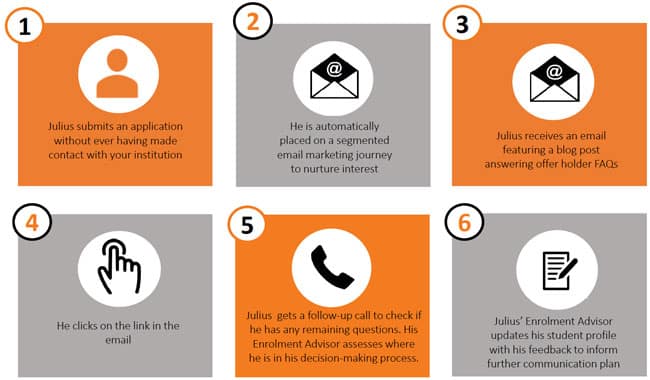
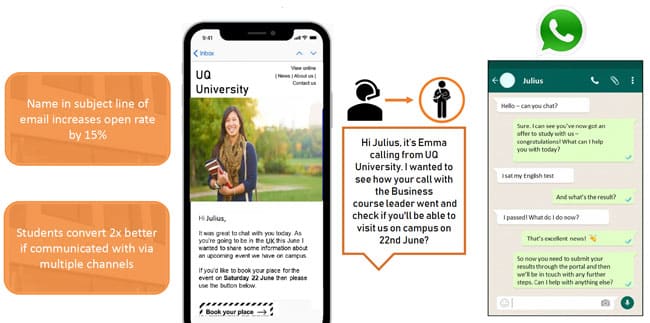
UniQuest recommends having a variety of methods and channels available to engage students in the way they prefer – and to ensure that outreach to students happens using the student’s time zone for best results.
Complexity in the enrolment funnel
In a recent presentation at the BUILA 2019 Conference (British Universities’ International Liaison Association) Ms Parsons explained,
“Today, people are no longer following a linear path from awareness to consideration to purchase. They are narrowing and broadening their consideration set in unique and unpredictable moments. People turn to their devices to get immediate answers. And every time they do, they are expressing intent and reshaping the traditional marketing funnel along the way.”
For additional background, please see:







