
WHO warning highlights continuing efforts to curb coronavirus in key Asian markets

- Efforts to control the COVID-19 outbreak are continuing in key markets, including China and South Korea
- Both countries are trying to re-open businesses and schools but the process has been uncertain with a number of delays and reversals
- Officials in both countries have also delayed this year’s national college entrance exams
As of 1 April 2020, the epicentre of the COVID-19 pandemic has shifted with nearly 800,000 confirmed cases worldwide.
While the United States, Italy, and Spain are currently reporting the largest number of cases, the World Health Organization (WHO) warned this week that the COVID-19 pandemic was “far from over” in Asia.
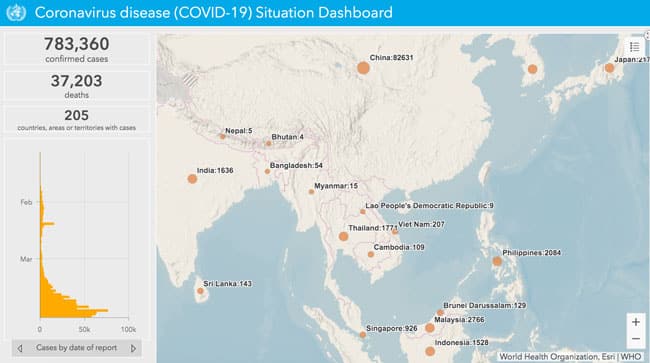
Some key international student markets – notably China and South Korea –have had great success in bending the growth curve of new coronavirus cases. The public health threats in both countries, however, are still very real.
Officials in China and South Korea are working to prevent a resurgence in new cases, and a number of restrictions remain in place.
Gaokao postponed
China has attempted to scale back its lockdown and to re-open businesses, factories, public spaces, and entertainment facilities. The results have been halting to date, however, and some re-openings of theatres and other attractions have been short-lived as authorities moved to order them closed again.
China’s university campuses remain closed, as do schools across most of the country. In an effort to resume the regular school year, officials are working to re-open schools, with the first students in some provinces returning to school this week. As of the end of March, 17 of China’s 23 provinces had either taken steps to re-open their schools or had formally announced dates for the resumption of classes. These include Qinghai, Guizhou, Xinjiang, Yunnan, Shanxi, Ningxia, Shaanxi, Jiangsu, Inner Mongolia, Sichuan, Anhui, Jiangxi, Fujian, Hunan, Jilin, Guangxi, and Hainan.
Also this week, the Chinese Ministry of Education announced that the gaokao – the country’s notoriously challenging and high-pressure national university entrance exam – will be postponed from its regular June dates to 7 and 8 July. Roughly ten million students sit the gaokao every year and it is very rare for the exam schedule to be altered in any way. The move comes, reports the , amid “growing fears of a second wave of coronavirus cases, underlining the difficulties countries face in returning to normal life even after successfully reining in infections.”
“Two months of school closures have left some students behind in coursework, particularly those who may not have easy access to online learning,” adds another recent item from . “However, as the number of reported domestic COVID-19 cases has dropped considerably in China, a portion of high school students have been returning to schools to prepare for the gaokao. Some provinces have announced that in-person gaokao classes will restart in April.”
Exams delayed in Korea too
Korean officials have taken a similar decision and South Korea’s national college admissions exams, which were to start on 19 November, will be pushed back two weeks with the exam cycle currently scheduled to begin on 3 December. Roughly 500,000 high school students sit the exams each year.
After postponing the start of the new school year three times over March, South Korea also recently announced that schools will re-open and classes will resume on 9 April – but only with online instruction. The government judged that it is reasonable to begin the new school year step by step starting on April 9 to take into account preparation situations and help students adapt (to online classes)," said Prime Minister Chung Sye-kyun.
For additional background, please see:







