
Survey: EU students much less likely to study in UK without home fee status

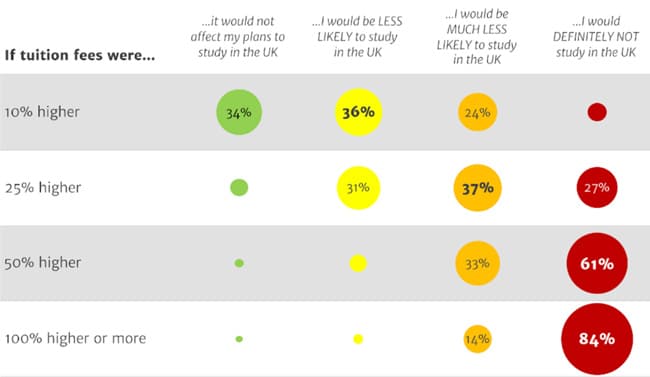
- More than half of EU students surveyed in June by Study.eu who had intended to study in the UK say that if tuition fees increase by 50% or more in the UK in 2021/22, they will “definitely not� study there
- If EU students had to pay the same amount of tuition as students from outside the European Union – almost a 100% increase over what they pay currently – 84% said they would “definitely not� study in the UK
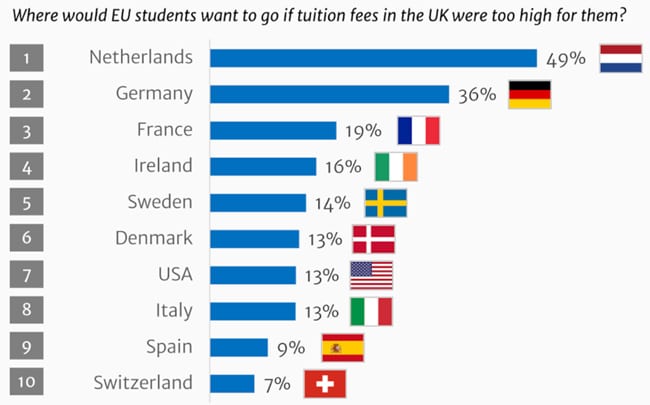
- The most popular alternate destination to the UK is the Netherlands, followed by Germany, France, and Ireland
In a series of annual announcements throughout the Brexit process, the UK had moved to protect home fee status for EU students – under which EU nationals are eligible for the same tuition rates and financial supports available to domestic students.
As we reported recently, however, England’s Minister of State for Universities announced last month that EU, EEA, and Swiss students planning to begin studies at English universities will no longer be eligible for home fee status as of August 2021. In a related development, study choice platform Study.eu has just released that asked EU students what they will do when “home fees” and public student loans are no longer available to them.
The survey was conducted 23–28 June among 2,500 EU respondents who had plans to study in the UK for a bachelor’s or master’s degree.
More than half of EU students said they would be adversely affected by the lack of public loans to help finance their education, and significant proportions said they would no longer consider studying in the UK if fees were increased by 50% or more.
More than 8 in 10 will not pay
Students were asked to respond to the following scenarios: (1) a 10% increase in fees, (2) a 25% increase in fees, (3) a 50% increase in fees, and (4) a 100% increase, which would bring fees to virtually the same amount that non-EU international students currently pay.
If they had to pay the same fees as non-EU international students (i.e., the 100% scenario), 84% of responding EU students would “definitely” not study in the UK, and 14% would be “much less likely.” Study.eu notes that “this could mean a loss of 120,000 students based on recent enrolments, or 25% of all non-UK students.”
If fees were raised by 50%, six in ten students (61%) said they would definitely not study in the UK and a further 33% would be much less likely.
Even a 10% increase would still be worrisome for UK universities, with 6 in 10 students saying they would be less likely to study in the UK if fees were just that much higher.
Commenting on the findings, Study.eu CEO Gerrit Bruno Blöss said,
“This is a lose-lose situation for everyone. It is unfortunate that the political process leads to such negative consequences for students and universities. We hope that some other solution can be found that would promote student mobility between the UK and the EU.
Where would they go?
EU students were asked which other destinations they would consider if higher education in the UK became unaffordable, and most chose alternate destinations in Europe. Nearly half (49%) said they would choose the Netherlands, followed by Germany (36%). Another 19% chose France and 16% Ireland.
How will UK universities cope?
Mr Blöss notes that the UK government’s late-June announcement of home fees being rescinded would not have come as a surprise to universities. He said they will have considered a range of strategies in response. “
“Most universities have been overhauling their marketing and recruitment campaigns for a while. After all, the announcement did not come unexpectedly. Some may shift focus to more affluent origin countries. At the same time, some are planning to open satellite campuses in continental Europe, to offer degree programmes in trans-national education settings. A few institutions are also evaluating potential legal loopholes to charge different fees.”
He added,
“Britain’s universities have a lot to offer, but they are facing strong competition on the continent. If they want to continue to attract students from the EU, they will need to communicate their excellent value proposition and make it clear that EU students are still welcome.”
For additional background please see:







