
Could digital nomads be an important growth segment for student travel?

- Travel researchers are noting explosive growth in the digital nomad segment: independent, remote workers who combine travel with flexible work commitments
- A growing proportion of travel operators are introducing new services targeted to this segment, and we can anticipate there are opportunities for educators here as well
Digital nomads are online workers that are “location independent”. They can, and do, work from anywhere. They lead “asset-light” lives and are invested in experiences rather than things. This makes them a growing and important segment for the travel industry, and travel operators and governments alike are adapting their service offerings and visa programmes to attract growing numbers of mobile workers.
Speaking at the , WYSE Research Advisor Greg Richards noted that the rapid growth of this segment has been driven by inexpensive travel options, the rise of collaborative, freelance work, and by a host of enabling services and tools, including mobile devices and co-working spaces.
Even before COVID-19, there were pronounced trends toward remote work, even among those permanently employed with an organisation. The pandemic has of course been a major accelerator of this trend. Nearly everyone became a remote worker this year, and the post-COVID workplace will likely look very different in the years ahead. Professor Richards notes that US office space is expected to contract by 17% this year and that eight in ten companies say the plan to continue to allow their staff to work remotely (at least part of the time). Most workers (71%) say they would also like to keep the flexibility of working remotely after the pandemic subsides.
WYSE, through its research series, has estimated the global population of digital nomads at roughly two million as of 2017.
Pieter Levels, who runs the destination ranking site , has projected that the global population for this segment will reach one billion by 2035. "Before the pandemic, we might have seen this as ideological dreaming," says Professor Richards. "But maybe now we might think that the reality would get somewhere closer to the one billion mark by 2035."
Who are the digital nomads?
The New Horizons research indicates as well that this is a segment that skews a bit older than the traditional student travel market, is well educated, and has the means to self-fund travel and related experiences.
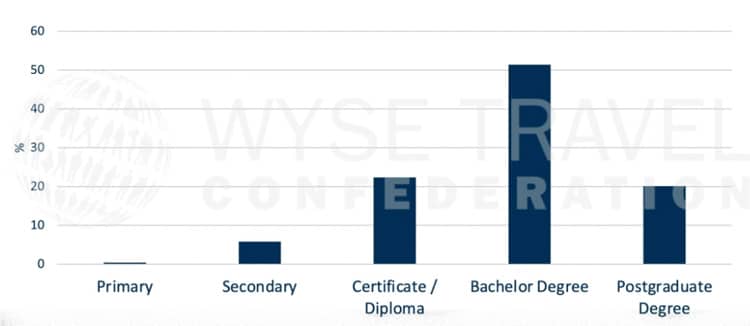
WYSE notes that the core of the digital nomad market is aged 26-to-29-years-old, and that more than seven in ten have at least a first university degree.
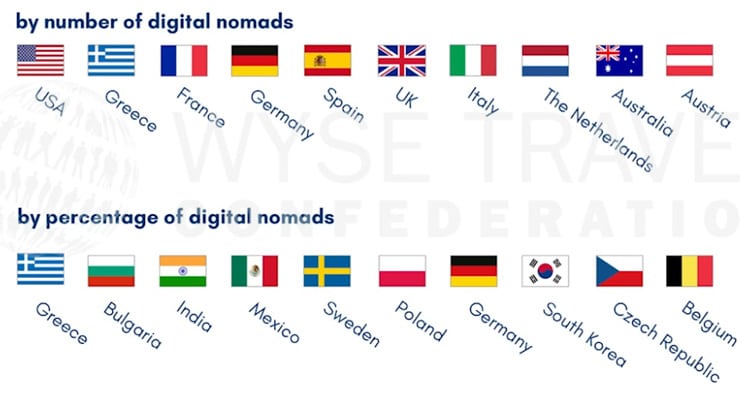
Most of these travellers undertake trips of one to two months in duration. Most are based in North America and Europe, and there is an interesting correspondence between the most popular destinations for these travellers and the top study destinations globally. The United States, France, Germany, Spain, the UK, and Australia, for example, are all among the top destination choices for nomads, and are also to be found at the top of the table of global study destinations.
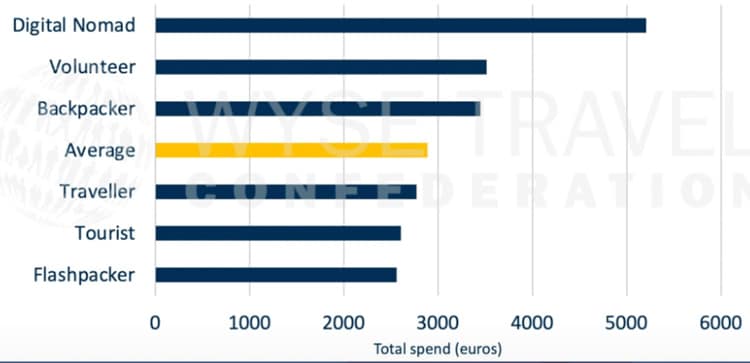
Not surprisingly, these travellers rely heavily on online sources (bloggers and video bloggers, in particular) for trip planning. And also as we might expect, this is a segment whose average travel spend well exceeds those of neighbouring cohorts as they are working, both before and during their travels.
WYSE Travel Confederation's September 2020 COVID-19 Travel Business Impact Survey found that 20% of members had already introduced new programmes and services specifically targeted to digital nomads, including co-working facilities, improved Internet access, online courses, and other digital services.
A new student segment?
So here we have a rapidly growing travel segment – well-educated, well-funded, and committed to travel and new experiences. This raises a number of questions for operators in the youth travel industry but for international educators as well.
Are there opportunities, for example, for schools to adapt their offerings to better target nomads through an expansion of co-working spaces and services for mobile workers? Or might higher education institutions expand their slate of micro-credentials or other alternative qualifications for remote workers who would like to combine flexible work commitments with skills upgrading abroad?
Whatever the case, Professor Richards advises anyone targeting this segment to think in terms of building community and relationships within the digital nomad segment and to "think digital". "These people are online all the time," he says. "They want to be able to receive information digitally and to be able to do everything online. If you are not providing services digitally, you are not in the market."
For additional background, please see:







