
Chinese border remains closed to foreign students

- Foreign students have been prevented from entering China since 28 March and frustration is growing as the extended disruption in degree studies continues for many students
- China had moved to ease some travel restrictions in recent months but they do not yet extend to international students
- More recently, international arrivals have been suspended for a number of key sending markets, including India, and new testing requirements introduced
China has been climbing the global table of leading study destinations over the past decade and is now the fifth-largest destination overall, after only the US, Australia, UK, and Canada. As the pandemic took hold this year, however, student mobility essentially ground to a halt. China closed its borders to foreign students on 28 March and those restrictions remain in place at this writing in mid-November.
China’s Ministry of Education announced in late September that roughly 90% of the country’s students had returned to their schools and universities at that point. While face-to-face instruction has resumed at many universities, Chinese media reports indicate that most are operating under strict restrictions, including – as part of COVID control measures – that students are essentially confined to campus. There have been regular reports of student protests and growing frustration around those campus controls through September and October, and Chinese authorities have signalled to universities that they should be flexible in their approach. But observers have noted as well that borders were unlikely to reopen to foreign students while any on-campus restrictions are still in place and while the virus continues to surge in a number of important sending markets, including India and the United States.
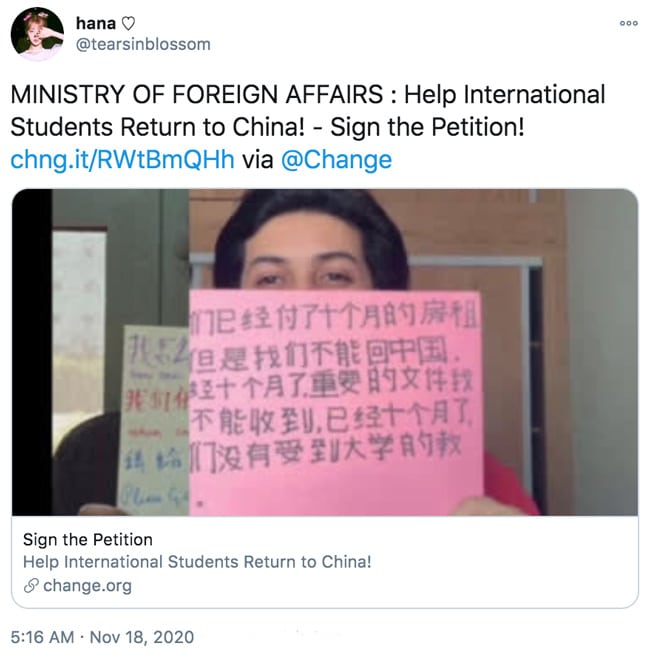
For their part, foreign students are growing increasingly frustrated at the continuing disruption to their studies, and with the considerable uncertainty and lack of communication or guidance from Chinese authorities. A new petition that opened this week has garnered thousands of signatures in its first two days. “We are the international students of China and we have been banned from returning to China for about 10 months and unable to continue our education as a result,” it notes. “Many students cannot carry out experiments in the lab and undertake research at all as well as medics are unable to attend internships and practical classes…We also have to take online classes at ungodly hours due to time zone differences and sometimes the quality of online classes is poor due to regional bans on software and internet issues.”
“I’m a third year medical student and we’ve been away from school for 10 months. We have to pay full tuition without even being on campus and we don’t receive updates or anything on our situation. Can someone please do something.,” added one signatory. “My future depends on my degree,” said another.
Changing rules
The persistent border closure for foreign students continues amid an otherwise fluid environment for foreign travellers hoping to enter China. The Chinese government began easing restrictions for some travellers in August. And, as of 23 September, foreigners with valid residence permits were for economic, trade, scientific, or technological activities, and also for humanitarian or family reunion purposes.
This meant that foreign academics, scholars, and researchers working at Chinese universities could once again enter the country even as the ban on foreign students remained in effect. A joint statement in September from the foreign affairs and immigration ministries said that China “will continue resuming people-to-people exchanges in a step-by-step and orderly manner".
More recently, the Chinese government has by adding additional testing provisions and temporarily suspending the entry of non-Chinese nationals from a number of countries, including Bangladesh, Belgium, Ethiopia, France, India, Italy, Philippines, Russia, the UK, and Ukraine.
All travellers arriving from abroad are now required to present negative results for two COVID tests – nucleic acid and IgM antibody tests – administered 48 hours before boarding. (Previously, travellers were required only to show a negative result for a nucleic acid test conducted within 72 hours of boarding.)
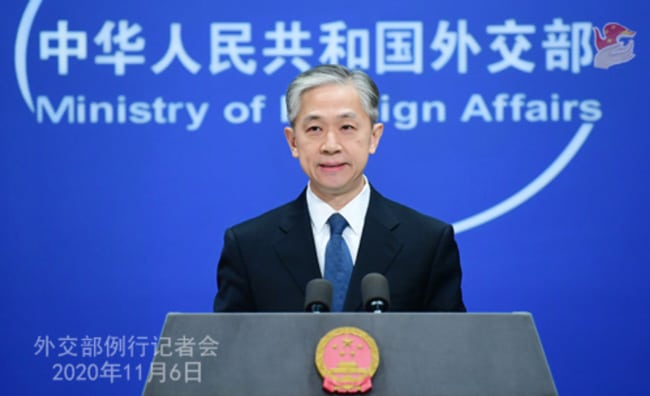
Those additional measures came into effect on 5 November. Speaking at a press briefing in Beijing that day, Foreign Ministry spokesperson Wang Wenbin said that China faces an increasing risk of imported cases as COVID cases spike in other parts of the world.
"Under such circumstances, we have drawn upon other countries' practices and further strengthened pre-departure prevention and control measures for travellers coming to China," he said. "This helps not only preserve the hard-won epidemic containment results in China but also minimise the risk of cross-infection during the travel and safeguard people's health and security…This is reasonable, consistent with international practice, and I believe it can be understood by everyone."
For additional background, please see:







