
Canada: Quebec shuts down immigration pathway for graduates of unsubsidised private colleges

- As of September 2023, only graduates of publicly funded universities and colleges in Quebec will be able to get post-study work permits
- The move comes in response to earlier findings by the Quebec government of questionable recruiting and business practices on the part of some unsubsidised private colleges in the province
A joint announcement from the Canadian government and Quebec's provincial government will effectively end post-graduate work opportunities for foreign graduates of some private colleges in the Province of Quebec.
On 7 June 2022, Quebec's Ministry of Labour, Employment and Social Solidarity and the federal ministry of Immigration, Refugees and Citizenship Canada (IRCC) announced . Under this new provision, only graduates of publicly subsidised institutions, including universities as well as both public and private colleges, will be able to get a work permit.
This means in effect that graduates of unsubsidised private colleges will no longer be eligible to work in Canada after their studies. The new measure comes into effect on 1 September 2023.
"Canada recognizes the tremendous social, cultural and economic benefits that international students bring to this country," said Sean Fraser, Canada's Minister of Immigration. "Making the change that Quebec requested to post-graduation work permit eligibility will improve the integrity of the program, bring Quebec’s private institutions further in line with those of other provinces and protect our well‑deserved reputation as a destination of choice for international students.”
A popular route for Indian students
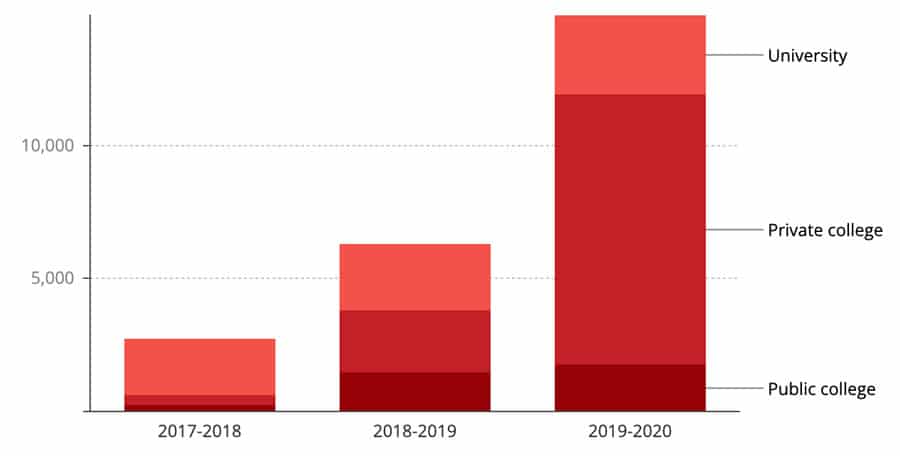
The number of students from India enrolled in Quebec institutions had particularly surged in the years leading up the pandemic, rising from less than 3,000 in 2017/18 to nearly 15,000 in 2019/20. As the following chart from CBC News illustrates, most of that growth was centered around unsubsidised private colleges in the province – that is, privately owned post-secondary institutes operating without any public funding.
Questions raised
The move follows persistent questions around the management of some private colleges in the province. A 2021 investigation by Quebec's Ministry of Higher Education found with "certain unsubsidised private colleges." Those audits, Higher Education Minister Danielle McCann said at the time, revealed "questionable practices in terms of recruitment, business practices, governance and teaching conditions."
The Minister added that the province would be taking steps to strengthen oversight for private colleges in Quebec, and the joint Quebec/IRCC announcement this week appears to be a broad brush approach to limit post-graduate work opportunities for students coming out of unsubsidised colleges - the idea being that the prospect of a post-graduate work permit has been a major draw for recruiting international students to those institutions.
“It is important to take action to protect the integrity of our immigration programs, which must promote sustainable integration into Quebec society," Quebec Minister of Employment and Social Solidarity Jean Boulet said this week. "These adjustments will help attract international students to come study in all regions of Quebec and ensure that Quebec is not used as a gateway for settling in other provinces.”
Minister McCann added, "A number of incidents pertaining to the recruitment of international students have occurred in the past and have caused us great concern. I am confident that these adjustments will make it easier for the international student community to integrate into our society.”
In one high-profile case within the sector, earlier this year. The three – M College (Montreal), CDE College (Sherbrooke), and CCSQ (Longueuil and Sherbrooke) – were jointly owned. Two of the three, M College and CDE, were among ten colleges that had previously been temporarily barred from admitting foreign students over parts of 2020 and 2021, out of concern over questionable recruiting practices in India.
Calls for transparency
Industry stakeholders have been quick to point out that the move to limit access to post-study work permits for all unsubsidised colleges, while expedient, has the effect of targeting all colleges in the sector unnecessarily.
A statement from the (NACC) calls on the Quebec government for greater transparency and to engage with the college sector to develop more effective and targeted quality controls.
“The NACC and our member institutions in Quebec are very disappointed by today’s announcement by the Quebec Government and Government of Canada," said NACC CEO Michael Sangster.
"Regulated Career Colleges play an important role the Quebec and Canadian economies, both of which are in desperate need of skilled workers to fill labour gaps in critical industries. This measure is a step backward in our country’s International Student Policy and economic recovery.
Our industry has, for many months, tried to engage the Quebec government to understand their questions or concerns pertaining to the post-graduate work permit and find workable solutions together, but they have not responded to our calls nor shared any information about their investigation and the substance of their report. Now, this report is the basis for drastic policy change that will seriously impact and unfairly target our international learners, high-skilled graduates, and the employers who rely on them.
A more effective step to protecting the integrity of the International Student Program in Quebec would be to transparently release the Quebec government’s report on this matter and consult with Regulated Career Colleges and all stakeholders, including industry, who will be impacted by this decision."
For additional background, please see:







