
Students grappling with effects of a strong US dollar

- An exceptionally strong American dollar is making it more expensive for students in many key emerging markets to afford travelling to and studying in the US
- This is changing the ways in which some students must consider their study abroad decisions
All indicators point to surging demand for study abroad among pandemic-weary college students. However, it is increasingly clear that devalued currencies, inflation, and knock-on effects of the Russia/Ukraine war may dampen that demand in several important outbound markets.
In recent weeks, we’ve reported on agents’ feedback about student decision-making factors in nearly a dozen countries, and the top two themes that emerged were that students are looking for affordability and, related to that, the ability to work while studying. Financial concerns are particularly pressing given the extremely strong US dollar – which recently hit its highest peak in 20 years.
How the dollar’s strength might affect mobility
The dollar’s rise makes it more expensive for students to study in the US, which in turn affects the factors they must prioritise in their study abroad decision-making. Students who only months ago might not have needed a scholarship or to work while studying are finding themselves in a precarious new position. If they don’t get financial aid or can’t see how they will supplement their existing funds, some may have to delay their plans of studying in the US or choose alternate, more affordable destinations.
For a sense of how many world currencies are being affected by this development (and why), please see this informative article, from which the following chart is excerpted.
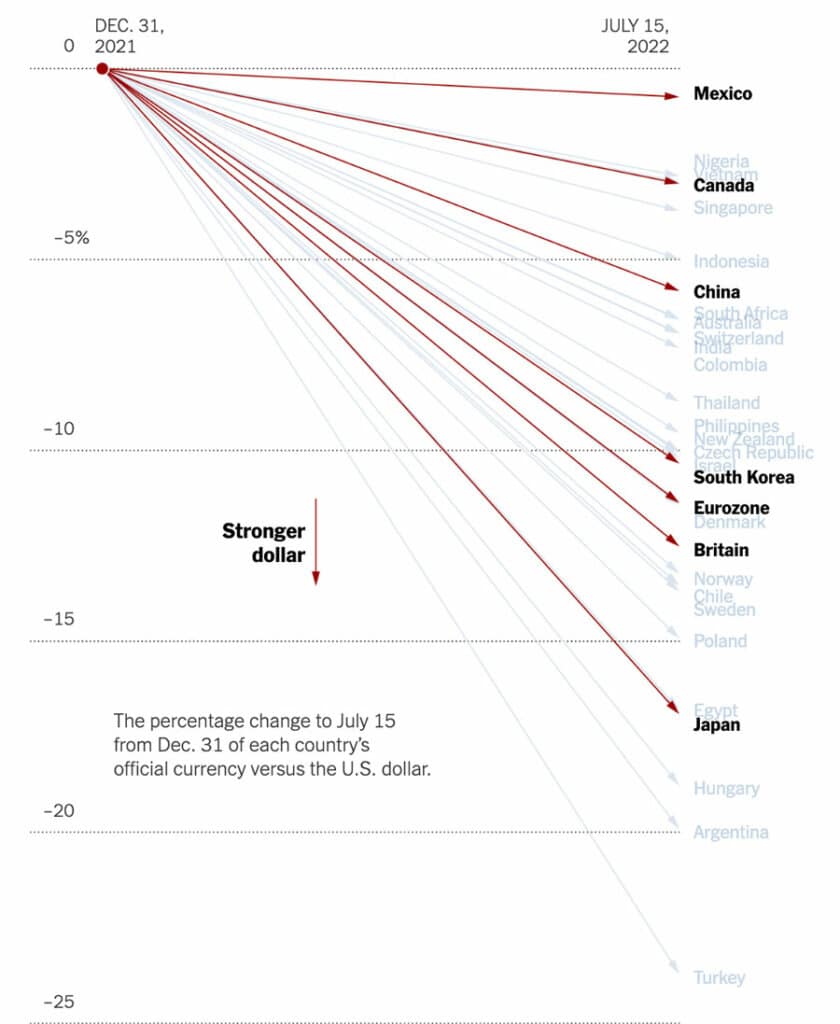
Devalued Chinese and Indian currencies are particularly worrisome for educators in the US given high reliance on these two source countries for enrolments. But there are many other countries in which students are facing the prospect of a more expensive education than they had planned for – including Nigeria, which is an increasingly important market for many educators.
How educators can manage the impact
Andrew S. Horsfall, assistant dean of international programmes at Syracuse University’s College of Law, has, since 2014, been tracking international-exchange rates twice a year. As per reporting in the Chronicle of Higher Education, Mr Horsfall discovered in his most recent study (in March 2022) that “students from 19 of the 23 countries he tracks would spend more in their home currency to pay their tuition costs than six months earlier.”
With this in mind, Mr Horsfall shared possible interventions that educators could take beyond increasing scholarships:
- “Re-evaluate international-recruitment strategy to focus on countries or regions where currency fluctuations haven’t been as great;
- Freeze tuition when currencies drop significantly or consider tuition reductions;
- Lock in tuition rates for students paying in foreign currencies when they first enroll so that they are not affected by fluctuations;
- Permit students to extend their payments over a longer period of time when it looks like a currency might stabilize in a few months;
- Encourage students to pay in full early when declines in a currency’s value are expected to continue;
- Relax discount rates over all or for a select group of countries."
Mr Horsfall’s tips are invaluable at a time when US institutions are (1) just beginning to recover from pandemic-related enrolment losses, and (2) increasingly pressed to diversify their international enrolments across a broad range of markets.
Incidentally, when asked what about a mistake he has observed made by some institutions recruiting his country, a top Colombian agent we spoke with for our recent survey said it was an unwillingness to be flexible – an adherence to “strict” rules – that made it less likely for students to be able to study there. Relatedly, that agent offered this tip for recruiters: “The Colombian market is price driven – look for how to offer higher value for less money.”
Clearly, it is a time for educators to consider adapting recruitment strategies in light of greater affordability concerns on the part of students from many emerging markets.
For additional background, please see:
- “The Indian rupee has lost a lot of value this year: how will this impact planning for study abroad?”
- “Nigerian demand surging but real challenges remain in visa processing and international payments”
- “What role can agents play in diversifying foreign enrolment across a wider range of fields of study?”







