
Affordability a rising factor in international students’ choice of destination

- Students and families are increasingly looking at affordable destinations for study abroad
- They can consult a growing number of news articles and rankings to compare countries and cities in terms of tuition and costs of living
Agents responding to our latest 91ɬÂþAgent Voice survey said that students are prioritising affordability above all else this year when deciding where to study abroad. Three-quarters of agents said that “cost of study and living” is the most important factor for students, above even work and immigration opportunities.

Suffice to say, for many students in emerging markets, immediate concerns – i.e., “can I even afford to study abroad?” – must currently take precedence over long-term goals such as immigrating to a preferred destination country.
Destinations on the rise
In a separate survey 91ɬÂþundertook this summer with agents in nearly a dozen top source markets, agents named countries such as Germany, South Korea, Spain, Italy, France, and Japan as destinations that are attracting more student interest than in the past. Not coincidentally, studying in these countries is often less expensive than in the leading English-speaking destinations of Australia, Canada, the UK, and the US.
We aren’t the only ones to notice increased interest in affordable study abroad options. For example, QS recently listed “” based on tuition fees and/or cost of living. The list includes, in order, Norway, Taiwan, Germany, France, Mexico, India, Argentina, Poland, Malaysia, and South Africa.
The global language testing company concurs with on Norway, Malaysia, France, and South Africa being inexpensive destinations to check out, and adds Greece and Spain for consideration.
It should be said, however, that while international students do not pay tuition in Norway, Norway is not known for affordable cost of living – and Norway is just one example of a country where lack of tuition does not necessarily mean students will need a small budget to study there. Students comparing destinations should factor in both tuition and cost of living when deciding whether they can afford to study there. With that in mind, provides a useful breakdown of study and living costs across destinations.
Looking more specifically at cities
Within destination countries, costs of living vary greatly on whether a school or university is in a small town or big city. Increasingly, institutions in regions and towns that tend to lose students to competitors in large metropolises are promoting cost of living in their marketing to international students.
The extent to which affordability can be measured not just at the country level, but also at the city level, is well illustrated in . Students consulting this ranking can compare how cities in the top 100 compare against each other in terms of study and living expenses. For example, if we look at the top 10 cities overall, it’s clear that if affordability is a top issue for students, certain cities perform better. The higher the affordability score, the more budget-friendly it is.
Looking at the table below, for example, students dead-set on studying in the UK might be interested to learn that not only is Edinburgh in the top 10, but that it is significantly more affordable than London.
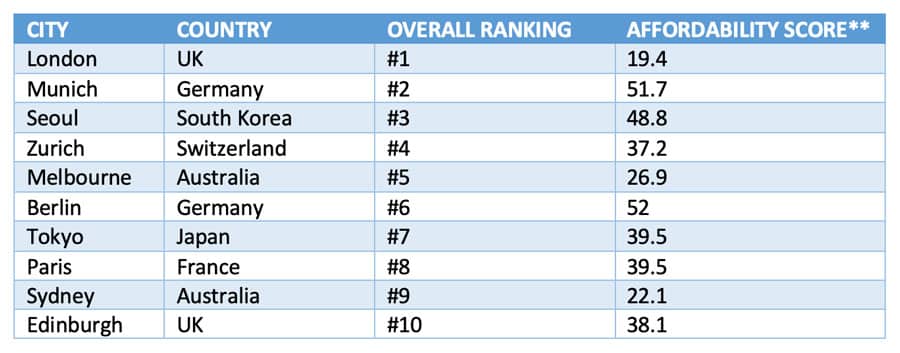
** The six factors determining a city’s overall ranking are “student mix, desirability, employer activity, affordability, and student voice.” Source: QS
Closer scrutiny
Going forward into 2023, we can anticipate that more students will be carefully evaluating costs of living and studying in their decision-making about where to study – because they must. Last week, World Bank Group President David Malpass issued a grim assessment of how the :
“Global growth is slowing sharply, with further slowing likely as more countries fall into recession. My deep concern is that these trends will persist, with long-lasting consequences that are devastating for people in emerging market and developing economies.”
In addition to questions about tuition fees, costs of living, and the availability of scholarships, educators should also be prepared to answer students’ queries about the opportunity to work while studying. Our agent survey in the summer of 2022 revealed that the ability to work during studies is currently even more important to many prospective students than post-study work opportunities. Again, this priority is driven by a need to find ways of making study abroad financially feasible.
For additional background, please see:







