
UK transnational education expands at fastest rate ever

- In 2020/21, UK institutions delivered transnational education (TNE) to more than 510,800 students in 228 countries – a 12.7% increase over the previous year
- Universities UK writes, “UK TNE numbers have grown across all regions at an overall higher growth rate than ever before.�
The sixth edition of Universities UK’s “” report shows that the UK – already the leading provider of transnational education (TNE) – is more active than ever in this space. More than 510,800 students in Asia, Europe, the Middle East, Africa, North America, Australasia, and South America were enrolled in UK TNE programmes in 2020/21. This marks a 12.7% increase over 2019/20.
The report was co-published with the British Council, and its data comes from the Higher Education Statistics Agency (HESA) Aggregate Offshore Record (AOR) covering students enrolled in UK TNE programmes between 2016/17 and 2020/21.
Universities UK defines TNE like this:
“The delivery of degrees in a country other than where the awarding provider is based. It can include, but is not limited to, branch campuses, distance learning, online provision, joint and dual degree programmes, double awards, ‘fly-in’ faculty, and mixed models, traditionally referred to as blended learning.”
In total, 162 institutions were providing TNE on 2020/21, up from 156 the previous year. Some educators are much more involved overseas than others: 15 institutions are responsible for 50% of all UK TNE enrolments.
Most types of TNE are experiencing growth
Of those types of delivery models, collaborative provision (e.g., joint and dual degree programmes) is most common (39%), followed closely by distance/online programmes (30%), then programmes delivered mostly in-country at a partner institution (22.5%). Collaborative provision has grown the most over the past five years (36% more students), and distance/online learning is also up significantly (+29%).
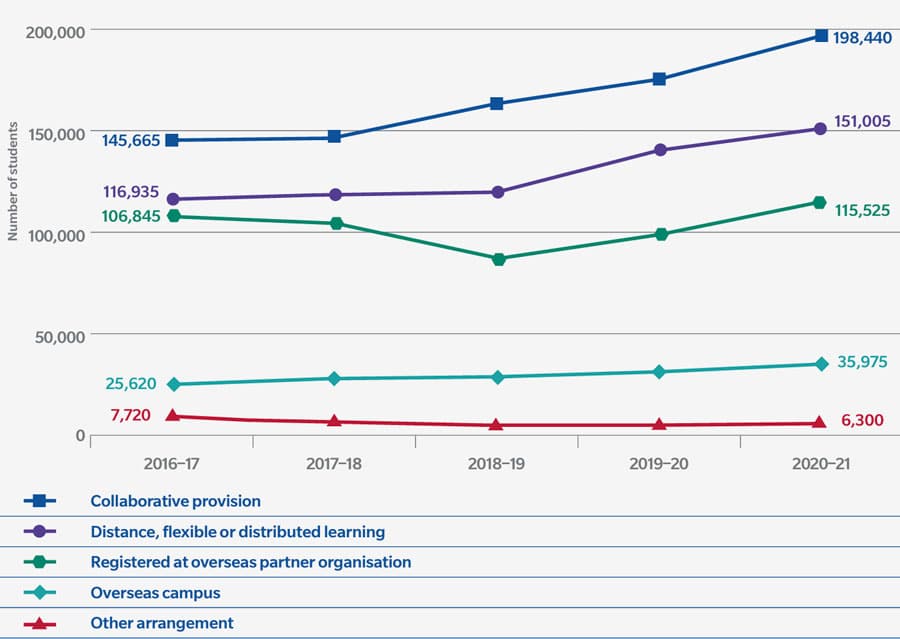
In terms of the type of TNE that is most prevalent in each region, the report notes that:
“Students registered at an overseas partner organisation were the most prevalent in the Middle East (47.9% of the regional total), while distance, flexible or distributed learning was the main type of provision in Australasia (99.0%), North America (81.1%), and South America (80.8%). There was also substantial overseas campus provision in the Middle East (13.6%).”
Distribution of students
Half (49.5%) of students enrolled in UK TNE are in Asia, but there are many students in the EU (16%), the Middle East (14%), and Africa (11%) as well. There are also students enrolled in North America (5.5%), other parts of Europe (3.5%), and Australasia and South America (roughly 1% each).
At the country level, China enrols 12% of the total (61,495). After that, the next largest shares of students are in Malaysia (9.5%), Sri Lanka (7.5%), Singapore (5.5%), and Egypt (4.7%).
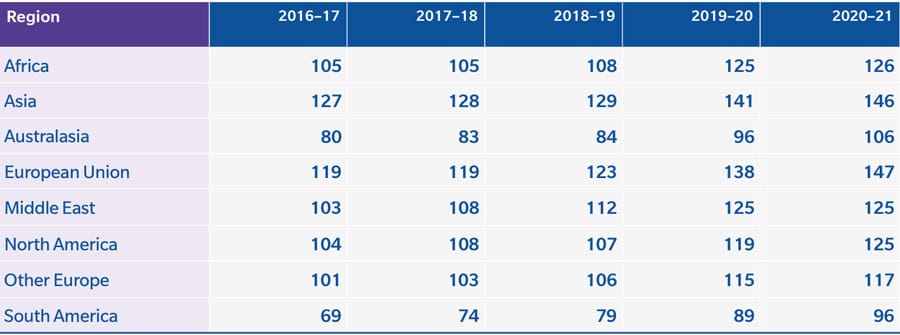
At the same time as EU students are a declining share of students in the UK, they are a growing segment for UK educators delivering TNE abroad. The number of students in the EU studying in a programme either wholly or partly delivered by a UK educator has increased by 44.5% between 2016/17 and 2020/21.
The following chart shows where UK TNE providers were operating in 2020/21 compared to previous years. As you can see, there has been significant expansion in the EU, perhaps as a way of offsetting declining EU enrolments within the UK itself.
Study levels
In 2020/21, 67% of students were studying at undergraduate level, 31.5% were master’s students, and 1.5% were pursuing post-graduate degrees.
Driving growth outside of China will be key
The report suggests that the pandemic accelerated the growth of UK TNE:
“The COVID-19 pandemic seems to have stimulated growth of UK TNE as countries were looking to enhance the quality of their domestic higher education systems and students were less willing or unable to travel abroad for their studies.”
At the same time, it points out that further growth is not to be taken for granted given the volatile geo-politics affecting so many world regions today. It notes the importance of diversification as a risk mitigation strategy given this time of uncertainty.
“While student numbers grew across all regions, China was the only top host country showing growth at a double-digit rate, and only a few new countries entered the list of top 20 host countries and territories. Identifying and reducing barriers to TNE in priority countries will be crucial to diversifying UK TNE provision and ensuring a sustainable spread of partnerships. The government aims to negotiate free trade agreements (FTAs) with the majority of the UK’s trade partners by the end of 2022."
For additional background, please see:







