
New report highlights the increasing competition for international students from Sub-Saharan Africa

- France is the top destination for students from Sub-Saharan Africa, but other destinations such as the US, Canada, Turkey, and Morocco are quickly becoming more popular
- The tremendous growth in African outbound student mobility is linked to a need to provide higher education to the burgeoning number of college-aged students in the region
A new report from sheds light on what’s happening in terms of outbound mobility from Sub-Saharan Africa – a region that encompasses Eastern and Western African countries south of the Sahara. These countries include Cameroon, Cote d’Ivoire, Ghana, Kenya, Nigeria, Rwanda, Tanzania, and Zimbabwe – new hot zones for many educators.
Capacity issues in their domestic higher education systems are the main push factor for Sub-Saharan African students. The college-aged population is expected to double by 2050, and currently only 9% of this cohort is enrolled in higher education. This imbalance, if unchecked, will almost certainly limit economic growth and social development, and could worsen security issues.
France has been a top destination for African students from Sub-Saharan countries for years, and it now enrols about a sixth of all outbound students from the region. But France is facing increased competition as more and more foreign institutions are focusing campaigns and other investments in Africa.
Top destinations and major senders of students
The Campus France report finds that Europe claims the largest share (27%) of the 430,000 Sub-Saharan African students studying abroad. France is the main host (14%), enrolling 92,000 Sub-Saharan students in 2021/22 (at least half of whom are university undergraduates), followed by Germany (18,900) and Portugal (14,900).
Significant volumes of students travel to other African countries (20%) – especially to South Africa – and to North America (15%).
The number of internationally mobile Sub-Saharan African students has grown by 21% over the past five years. This mobility rate is now much higher than that in other world regions: 4.8% versus the 2.7% world average.
Nigeria is the main sender of students to other countries (72,000), followed by Cameroon (27,000), and Zimbabwe (19,000). Campus France finds that Nigerian outbound has declined by 24% since 2015 – in contrast to a general trend of increasing outbound mobility from the region.
The most popular destinations for Nigerians are the US, UK, and Canada. For Cameroonians, France and Germany are top choices. Zimbabweans tend to favour South Africa.
Other markets on the rise are Ghana (where the number of outbound students is up 62% since 2011) and Cote d’Ivoire (up 87%).
Trends in destination popularity
France has had great success in enrolling more Sub-Saharan African students in recent years (up 40% between 2016-21). The US is also on the move, enrolling 20% more students from the region in the past five years. But it’s Turkey (up 187%), Canada (up 67%) and Morocco (up 61%) that can claim the highest rates of growth in the past five years.
By contrast, South Africa and the UK are down 14% and 9%, respectively, in that time frame.
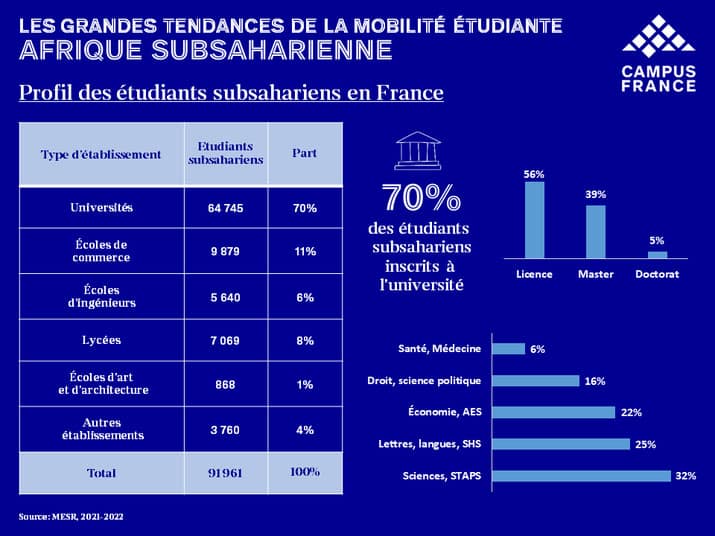
The following graphic from the Campus France report provides a sense of which kinds of study are the most attractive to Sub-Saharan African students right now. Licence (bachelor’s) and STEM are the main draws for African students heading to France.
For additional background, please see:







