
A big picture view of student mobility through 2050

- A new analysis from HolonIQ projects an additional one billion post-secondary graduates worldwide through 2050
- Driven by that strong demand for higher education, international student numbers are also expected to surge through the rest of this decade and beyond
- Total direct spending by international students is projected to more than double from pre-pandemic levels to reach US$433 billion by 2030
A March 2023 webinar from sector research specialists HolonIQ set the stage for an expanded effort to map global student flows, and highlighted important projections for the coming decades.
In "," HolonIQ’s Co-CEO, Patrick Brothers, and Vice President, Education, Lucy Blakemore, drew on macro-economic and population indicators to make a case for expanding global demand for higher education over the next 30 years.
Previous analyses from HolonIQ have projected that global mobility for higher education would expand from a pre-pandemic level of five million students to as many as eight million students abroad by 2030. Mr Brothers and Ms Blakemore reflected on that forecast during the webinar – and said it now appears to have been too conservative.
They noted in particular the rapid expansion of populations in Asia and Africa. Both continents are expected to account for a greater share of the world’s population as we move towards the end of this century. Asia and Africa are projected to account for approximately 80% of the total global population somewhere between 2060 and 2070.
Those overarching trends have helped to inform a further projection from HolonIQ that there will be an additional one billion post-secondary graduates added through 2050, three in four of whom will come from either Asia or Africa.
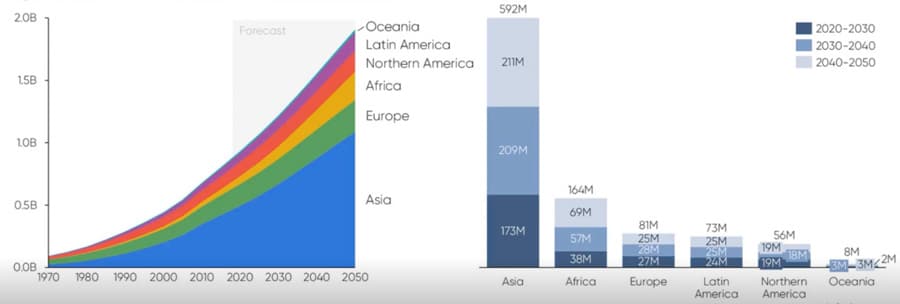
The analysis concludes that many students will be seeking an English-taught degree or qualification. Roughly half of the top 500 universities worldwide are in the US, UK, Canada, or Australia.
Global demand considerably exceeds the enrolment capacity of those top tiers of institutions, however. which will lead to a more competitive context for international recruitment going forward.
Shifts in share
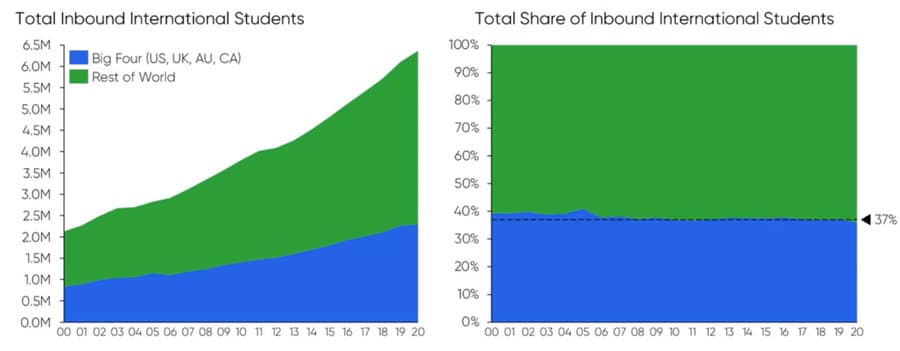
HolonIQ points out that the "big four" destinations have collectively held a very steady share of internationally mobile students since 2000. Those destinations' combined share has been stable at about 37% over the past 20+ years. The US, UK, Australia, and Canada's combined share of direct spending by international students worldwide is very high (80%), mainly because the cost of living and tuition is higher in those four countries than in most other countries.
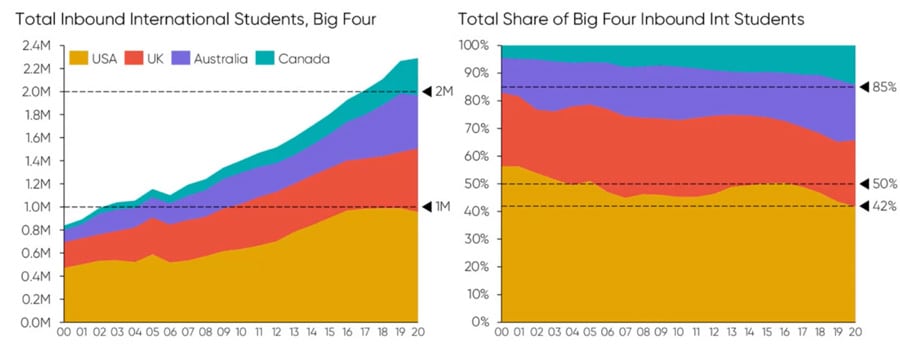
Mr Brothers noted that within the "big four," there have been notable shifts since 2000 in market share of international students. The US, in particular, has lost approximately 15% in share to the UK, Australia, and Canada since 2000, especially between 2015 and 2020. Canada gained the most share in that period.
Along with the projected dramatic growth in international student numbers through the rest of this decade, HolonIQ is forecasting a major expansion of direct spending on international education. Total student spending is expected to more than double to US$433 billion by the end of this decade (from a pre-pandemic base of just under US$200 billion).
That forecast is informed by a number of important strategic shifts affecting international education, including:
- The emergence of new types of credentials, notably shorter more flexible qualifications and even micro-credentials;
- A closer integration between higher education, employment skills, and work;
- New dimensions of competition across borders, including a greater emphasis on transnational education or remote delivery;
- The normalisation of multi-channel learning, with an expanding range of delivery modes and student experiences integrated within programmes of study.
For additional background, please see:







