
Education agents the primary channel for K-12 recruitment in China

- Nearly nine in ten Chinese parents said that education agents were the information source they relied on most when planning for their children’s studies abroad
- A similar proportion said that they applied for K-12 admission through an education agent
- This represents a roughly 20% increase in the reliance on education agents among Chinese parents compared to a previous survey cycle in 2021
A newly released survey from the UK-based (BSA) finds that agents now play an even greater role in recruiting Chinese students for independent K-12 schools in the UK. The survey gathers responses from nearly 1,000 parents of students who are already enrolled or have already applied to a UK school.
Education agents were overwhelmingly ranked as the top source of information by parents with 86.5% saying that they relied most on agents (up from 74% at the time of the last survey cycle in 2021). This compares to the 52.5% who said they turned to school websites, recommendations from friends and family (46.9%), and school visits (27%).
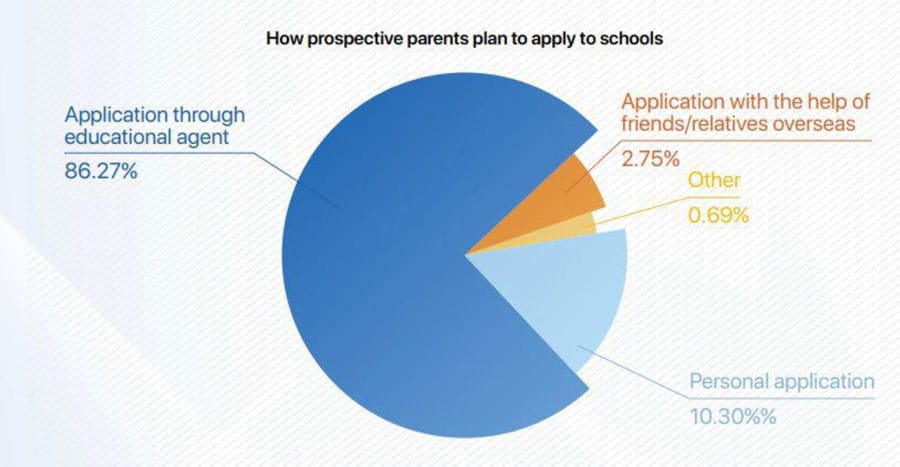
Similarly, nearly all respondent-parents (86.3%) of prospective students said that they intended to apply through an education agent (up from 71% in 2021). Among respondents of currently enrolled students, 88.49% said they had applied through an agency, another notable increase from the 78% who said they did so in the 2021 survey.
“It is increasingly clear from our surveys, that agents have been playing a more and more important role in the admission process. UK schools need to be aware of this trend and work more closely with agents," said the survey report.
For parents of prospective students, local accreditation was a top factor in choosing an agent (96% rated this as "important" or "very important"), alongside provision of guardianship services (97%), recommendations from friends and family (77%), and fees (67%).
Other notable changes from the 2021 survey include:
- Reasons for study abroad. Most respondents (73%) cited "pressure from the current Chinese education system" as the main reason for exploring study abroad (up from 41% in 2021). This was followed by an interest in "a more well-rounded education" (70%), and getting on a pathway to enter a top-ranked university (50%; up from 33% in 2021).
- Destination choice. Along with the UK, parents were most likely to consider the US, Canada, Hong Kong, Singapore, and Australia when planning for K-12 studies abroad. "Security and safety and educational quality were rated as the top two factors in choice of destination," adds BSA. "But employment prospects/immigration possibility was more prominent this year at 28%, compared with only 12% in 2021."
For additional background, please see:







