
Mapping “sweet spots� of opportunity for fields of study with high international student demand

- A new report identifies 10 subjects at the bachelor and master’s level characterised by high student demand and relatively low supply in terms of the number of programmes offered around the world
- The insights are relevant both for university leaders as well as admissions teams and international student recruiters
Studyportals recently analysed vast data sets to identify potential sources of competitive advantage for institutions marketing subjects to international students. The resulting report, “Subject opportunities for 2024, isolated “sweet spots,” which – in this context – are “subjects with high demand, in low supply.” To read the methodology for how those “sweet spots” were determined, .
Highlights from the report include:
- Artificial Intelligence (AI) is the only subject that appeared in the top 10 lists for both bachelor’s and master’s programmes;
- Relative to demand, Artificial Intelligence, User Experience Design, and European Law are characterised by undersupply at the bachelor’s level;
- Relative to demand, Data Science & Big Data, Artificial Intelligence, and Robotics are undersupplied at the master’s level.
The analysis provides interesting food for thought both for university leaders assessing their programme portfolio and international student recruiters determining points of competitive advantage in different markets.
Demand trends for bachelor’s degrees
The following graphic shows the 10 top subjects for 2024 at the bachelor’s level.
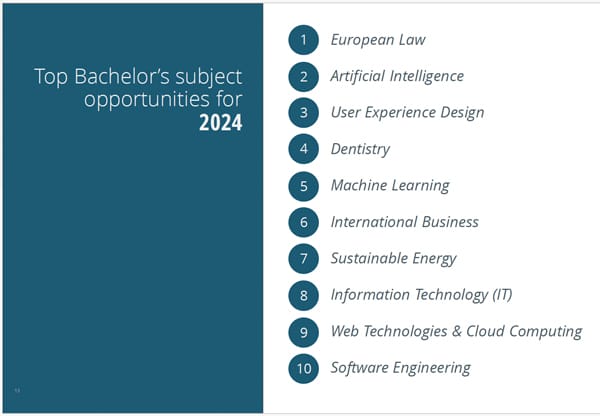
Looking at the top three subjects (we have rounded percentages to the nearest .5%), European Law is characterised by 3.5% more student interest than available programmes. Demand for this subject grew robustly by 33% over last year. The top sources of demand naturally come from Europe, especially from the Netherlands, Germany, Italy, Poland, and Romania.
There is 4.4% more student interest in Artificial Intelligence than there is availability and demand for AI subjects grew by an impressive 36% over last year. Demand is strongest among Pakistani students.
Demand for User Experience Design (UX) – a skill set that is strongly associated with digital products but whose application is much broader than that – is 33% higher than last year. There is 3.5% more student interest than there is supply of UX subjects, and Belgium, Sweden, and the Netherlands are the top destinations students search for when researching this subject.
Other highlights at the bachelor’s level are that student interest in Sustainable Energy and Web Technologies & Cloud Computing grew by 44% and 54%, respectively, over last year.
Master’s trends: Top subjects
The following graphic shows the 10 top subjects for 2024 at the bachelor’s level. Data-based fields take the top three spots, and STEM-based subjects dominate the list.
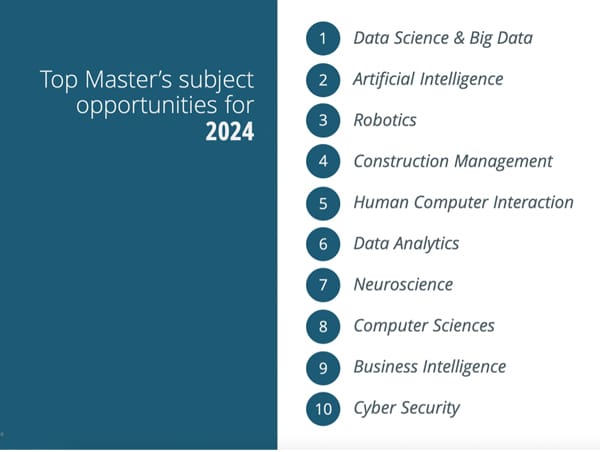
In terms of the top three subjects, student interest in Data Science & Big Data is more than double (2.5 times) the available supply and up 22% over last year.
More than half of all master’s programmes in Artificial Intelligence are offered by UK or US institutions – but there is clearly room for other competitors to jump into the field given that student interest is 2.5 times the supply of available programmes and demand is up 24.5% over last year. The range of AI programming is expanding as more and more industries and employers (including in international education) have incorporated machine learning into their processes.
A growing number of institutions are getting into the area of Robotics; as Studyportals notes, the number of master’s programmes in Robotics increased from 163 in 2019 to 264 in 2023. There is 2.5% more student interest than global supply, and demand has risen 15.5% over last year.
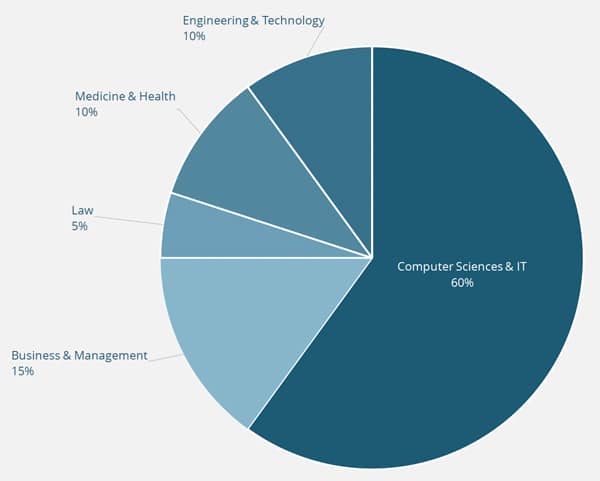
Computer Sciences & IT dominate
A few years ago, we might have expected Engineering & Technology or Business & Management to account for the lion’s share of “sweet spots” – those fascinating intersections of high demand and low supply. But the supply of programmes in those fields is now abundant – it’s Computer Sciences & IT where a lot of the opportunity now lies.
Recommendations
The Studyportals report authors offer some excellent recommendations both for university leaders and for admissions/recruitment teams. For example, they underline the importance of partnering with industry “to ensure that the programmes are aligned with current job market needs.” Guest lectures, internships, or collaborative research projects are some of the options to be considered.
For recruiters, the authors have these recommendations:
- “Increase the variety of programmes targeting international students to appeal to a broader range of students and increase the number of international students across your portfolio.
- Diversify recruitment focus countries to take advantage of interest in these subjects to increase the number of applications from around the world.
- Highlight employability – by promoting in-demand subjects, you help align the university’s offerings with the labour market’s requirements, making your institution a more attractive option for students concerned with employability.”
Consult for a more detailed breakdown of trends in the top 10 subject areas at the bachelor’s and master’s levels, and for an understanding of the methodology behind the report.
For additional background, please see:







