
Business school survey again signals declining non-EU enrolment in UK

- 76% of UK business schools are reporting declining non-EU enrolments for the January 2024 intake, with declines more severe at the post-graduate level
- Most schools also report that they did not reach their enrolment targets for January 2024, with declines reported across a number of major sending markets
The most recent survey from the Chartered Association of Business Schools in the UK reveals that, "International student enrolments have significantly declined in UK business schools, with the sector pointing to the government’s immigration policies as a cause."
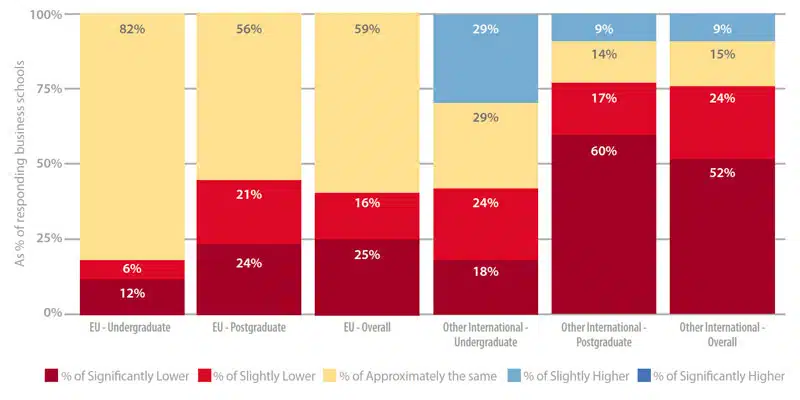
The were released at the end of February 2024 and they are based on survey responses from 50 UK institutions. Just over three quarters (76%) of responding schools said that their non-EU enrolment declined at the January 2024 intake. As the following chart illustrates, just over half reported significant declines, with postgraduate enrolments especially impacted.
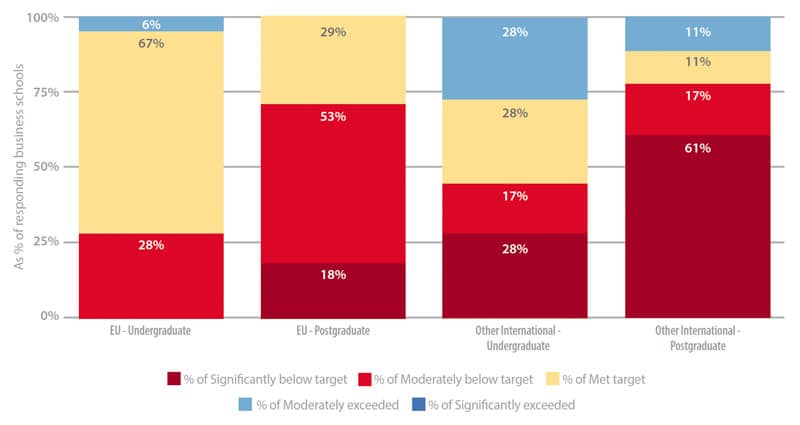
The additional chart below illustrates institutional performance against recruitment targets for the January 2024 intake, and, again, we see that a considerable majority of business schools are missing their target enrolments, with postgraduate programmes particularly affected.
“These latest results show the potential for the government’s immigration policies to severely damage one of the UK’s most successful exports," said Robert MacIntosh, Chair of the Chartered Association of Business Schools and Pro-Vice Chancellor for the School of Business and Law at Northumbria University. "The decline in international business student enrolments will limit a vital source of universities’ income which underpins the cost of teaching and research across subject areas far beyond business and management."
“Whilst we support a robust and fair student visa system, regressive policies on international students puts universities’ financial sustainability at risk at the very time when they are responding to rising costs and falling real-terms fees from UK students. Not only is our international prestige and soft power abroad under threat, so too are the jobs and the local economies which thrive around our great universities.”
Professor MacIntosh's sentiments were backed by the survey respondents, nine out of ten of which strongly agreed with the statement, "Recent government policy announcements, including the ban on visas for student dependents, are having a negative impact on my business school's ability to recruit international students."
A previous CABS survey, along with other early market indicators, had especially highlighted India and Nigeria as two key sending markets where the new policy settings preventing accompanying dependents has had a significant impact. The CABS report adds, however, that, "This trend extends beyond [India and Nigeria], with enrolments from regions including Europe, South Asia, and Latin America also experiencing declines, pointing to recruitment challenges across many markets. It was predicted that declines in applications and the conversion rate of applications to enrolments may intensify, particularly from the aforementioned regions, potentially exacerbated by the government’s new policy prohibiting dependent visas for families of international students."
For additional background, please see:







