
SEVIS data reveals decline in international enrolments in the US in 2024/25

- A new analysis of March 2024–March 2025 visa data shows a decline in international student enrolments in the US, especially from India and especially in master’s-level programmes
- That data reflects an earlier timeframe than can be attributed to President Trump’s policies, but those policies will almost certainly further pressure foreign enrolments in the US
Correction: The underlying SEVIS data on which this report was based was subsequently found to be incorrect, with actual foreign enrolments for the period March 2024 – March 2025 significantly underreported. The Department of Homeland Security published corrected data for the period on 2 July 2025, which we have reflected in our updated reporting here.
The Institute of International Education’s (IIE) Fall 2024 Snapshot reported in US colleges and universities as of the start of the 2024/25 academic year, but a new analysis of Student and Exchange Visitor Information System (SEVIS) visa data shows that international enrolments in the US declined overall during the year.
The analysis was conducted by , a professor and higher education specialist at Boston College and an affiliated faculty member at the Center for International Higher Education (CIHE).
Mr Glass says that SEVIS data shows a year-over-year foreign enrolment decline of -11% between March 2024 and March 2025, which, he estimates, represents up a loss of up to US$4 billion in economic impact (accounting for reduced spending on tuition and living expenses).
For context, he notes, the COVID-19 pandemic prompted a -15% decline in foreign enrolments – so the -11% drop in 2024/25 is getting close in scale to the fall-off during that incredibly disruptive time.
This drop does not account for policies enacted by the Trump administration, but rather occurred during the era of the Biden administration. President Trump’s policies (including an expected upcoming travel restriction) will likely further pressure foreign enrolments. The impact of the current administration’s policies on international enrolments in the US will not show up in enrolment data for months yet.
The March 2024–March 2025 decline was felt at all levels (and especially at the master’s level) and for language programmes as well as degree programmes. It picked up speed during the fall of 2024.
What is fuelling the decline?
Mr Glass points out that the structural components of the drop include changing flows from key source markets as well as record-high visa refusal rates.
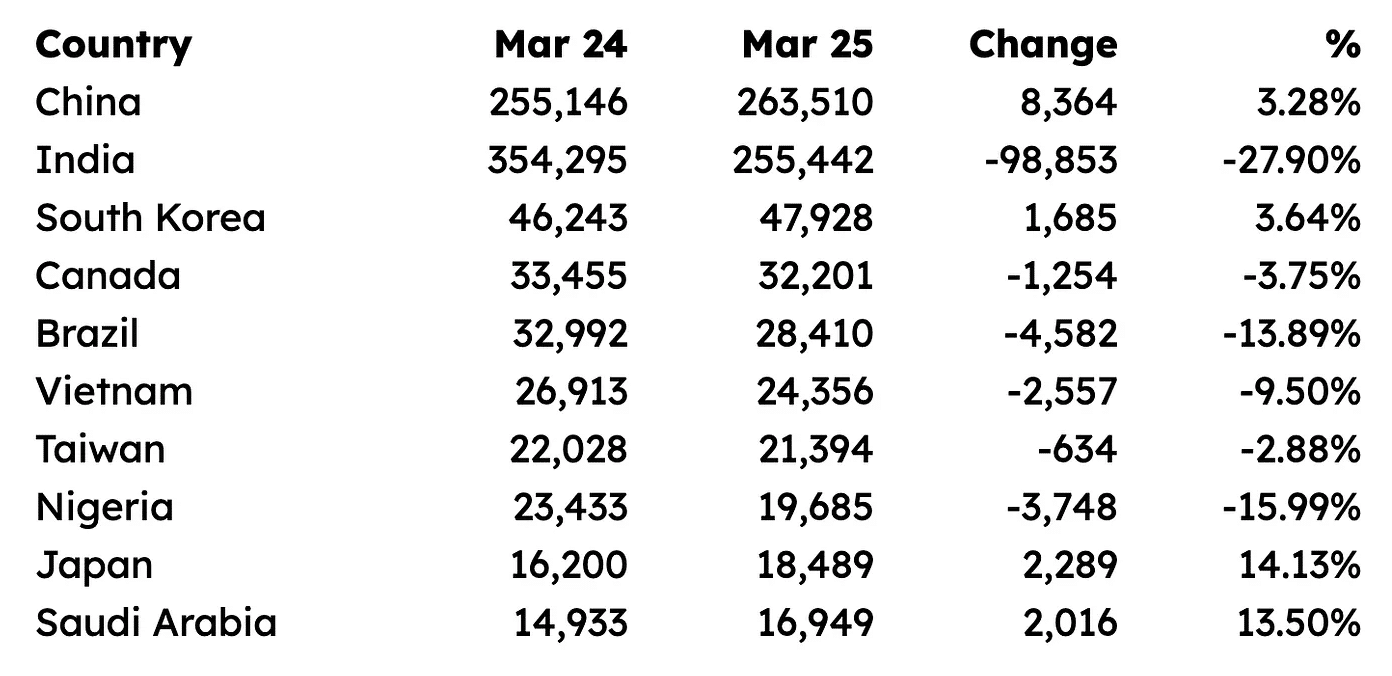
Notably, there was a -28% reduction from India, reversing a growth trend from that market. Indian students tend to be drawn to graduate STEM programmes, and the massive decline from India is associated with an overall -20.5% reduction in foreign enrolments in master’s programmes in the US. Meanwhile, foreign enrolment in bachelor programmes remained stable year-over-year.
The master’s trend should not only be viewed in terms of enrolments, says Mr Glass:
“More importantly, as I’ve argued, international graduate students aren’t supplemental income—they’re critical scientific infrastructure. They don't merely augment American scientific leadership—in many critical domains, they constitute it.”
Current crackdown on student protesters will likely further depress enrolments
Mr Glass points to affordability issues, visa processing times and refusal rates, and permanent residency opportunities in other destinations as likely factors behind the fall in Indian student numbers. We can imagine that demand from India is being further depressed by stories circulating in India about some Indian students’ treatment in the US. For example, Fulbright scholar and Columbia University student Ranjani Srinivasan was – without any notice – told her study visa had been revoked in March 2025. Her dorm room was visited, then raided, by US Immigration and Customs Enforcement (ICE) agents. Before ICE could detain her, Ms Srinivasan fled to Canada. She later learned her participation in pro-Palestinian protests was part of the reason .
Here is Mr Glass’s table showing what happened in all major markets for US colleges and universities. According to IIE data, Brazil was a top ten market in 2023/24 and had grown by 5% that year, but as you can see below, SEVIS data shows a -14% decline in March 2025 compared with March 2024. Similarly, IIE data indicates a -13.5% increase from Nigeria in 2023/24; the March 2025 SEVIS data now shows a -16% decline from this market.
Potential impact of a travel ban
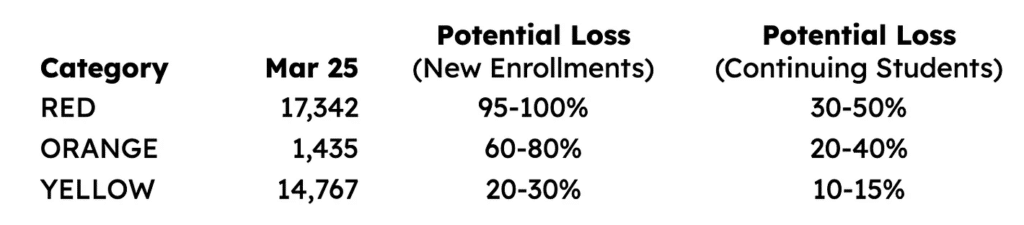
The Trump administration is considering that would come into effect in the next few months. In a draft version of the plan, the 43 countries have been categorised into tiers, with RED countries most restricted, ORANGE the next tier, and YELLOW the last. The following table represents Mr Glass’s forecasts of the potential loss of enrolments from countries in each tier if the travel ban does go into place.
Potential impact of funding cuts
Government funding for scientific graduate programmes has been massively slashed in the past three months. One programme, the (NSF), saw its budget reduced from US$9 billion to US$3 billion. The US National Institutes of Health (NIH) funding organisation has also received a -78% reduction in available budget, with Columbia University, in particular, targeted for major cuts. On top of an initial freeze of US$400 million from the NIH, Columbia learned this week . The freeze is linked to the government's conclusion that Columbia has not done enough to clamp down on pro-Palestinian protests.
Mr Glass explains the far-reaching consequences of the funding cuts:
“These cuts strike at the heart of graduate education funding, particularly for international students. Federal funding serves as the primary support for 5% of STEM master's students and 26% of STEM doctoral students. Among federally supported students, 69% receive research assistantships funded by federal grants.”
He predicts that the cuts will drastically affect the number of international students in STEM-focused graduate programmes: “I currently estimate between 50,000 and 77,000 international STEM graduate students could be affected—approximately 10% of the total international STEM graduate population.”
Is the writing on the wall?
The Institute of International Education (IIE) releases its report on international student enrolments in November of every year. But Mr Glass says:
“We don't need to wait for November to see the warning signs. The data on the dashboard are flashing red before our eyes.”
Mr Glass paints a challenging picture of the future of the US’s world-leading role in higher education and science if trends continue:
“The dramatic shift in international student enrolment has the potential to reshape American higher education in ways that would be difficult to reverse. I don't think this is just another cyclical fluctuation—but rather a more fundamental restructuring that will have profound implications for university finances, research output, and America's position in the global knowledge economy.”
For additional background, please see:







