
How likely are students to recommend your institution?

- Since 2018, the International Student Barometer (ISB) has found that employability is the top concern for university students
- Feeling prepared for a career is strongly correlated with student satisfaction, and satisfied students are naturally more likely than neutral or dissatisfied students to recommend their institution
- The ISB scores institutions on a metric known as the Net Promoter Score (NPS)
- North American institutions scored considerably above the global average for NPS
Findings from the latest wave of the International Student Barometer (ISB) are out, and the survey found that employability is only becoming more significant as a factor in students’ choice of institution and programme. It is such a pressing concern that it influences students’ satisfaction, and in turn, their likelihood of recommending their institution to others.
is the world’s largest international student experience survey of enrolled students, and it is conducted and analysed by Etio (formerly i-graduate). This latest wave generated 192,581 student responses, including 122,975 international students, studying at 155 institutions in 24 countries.
Rethinking career services
“Future career impact” has been the most important determinant of study abroad decision making since 2018, and this year it came in at 96%, compared to 94% for “specific course title” and “university reputation.” Other top influences were “research quality,” especially at the post-grad level, and “earning potential” (93% each).
In a webinar devoted to discussing the findings, Nannette Ripmeester, director client services for Europe and North America for Etio, noted that she often hears university staff wondering why their students aren’t more satisfied with career supports despite improved institutional attention to that aspect of the study experience. She says that often, the problem is that preparing students for work is a siloed or even one-off endeavour:
“Students really expect more. It’s not just a workshop at the end. That’s not going to do the trick. Employability must be really integrated into your curricula, and from first year to last year, it should be embedded in everything.”
Previous waves of the ISB have asked only final-year students about career preparedness, but this year, this expanded to students in earlier years as well. The research found that career concerns are prevalent in all years, suggesting that institutions should integrate work-related programming – e.g., lectures or entire units being delivered by industry professionals, work placements/internships, career advice and other supports, alumni networks, etc. – across the whole student journey.
Globally, 80% of final-year students said they feel prepared for their career goals. Ms Ripmeester noted that while this is a solid majority, it also means that 1 in 5 surveyed students do not feel prepared to meet their career goals when they graduate.
Costs and safety also matter
Not surprisingly, given the topsy-turvy economic context and persistent inflation in many countries in 2025, costs of living and studying also weigh on students’ minds when they are choosing where to enrol and while they are enrolled.
Safety is another top concern, especially for Chinese and Saudi Arabian students and their parents. Robin Hallows, the head of surveys for Etio, noted that good safety measures and a strong safety record should not be overlooked in promotional materials, saying it can go a long way in influencing students’ choice of destination and institution.
Related to safety is a student's experience in a host country as a foreigner. Globally, 1 in 5 students said they had experienced some form of discrimination (e.g., race or nationality), with Chinese students particularly likely to have felt targeted.
How likely are students be brand advocates?
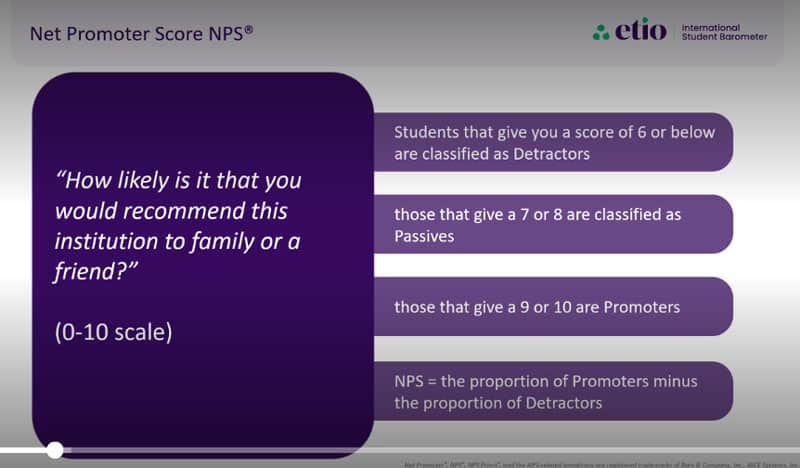
During the webinar, Etio panelists explained an important metric they are tracking in the ISB: the Net Promoter Score (NPS). This score is based on answers to the question “How likely is it that you would recommend this institution to family or a friend?”, where students were asked to pick a number on a scale of 0–10, where 10 is the most likely to recommend.
The following screen grab from the webinar explains how the NPS is derived. The higher an institution’s NPS, the more active promoters (or brand advocates) they have within their student body. This is an incredibly important metric given that the opinion of current students is highly influential for prospective students deciding where to study.
Don’t ignore AI
This wave of the ISB asked students for their opinions about artificial intelligence (AI). Fully 94% said it improved their study experience. Whatever academics’ concerns are about AI and studying, there’s no debating the fact that students are using it, and happily.
For additional background, please see:







