
Is Canada valued more as a “pathway to immigration” or as a destination for education?

- A global survey of study abroad counsellors and country managers offers some important findings for Canada’s international education sector
- The survey analysis argues for more stable and transparent international student policies in Canada, but also for institutions to expand career services and other student supports and for a collaborative effort to sharpen Canada’s market position
During a 12 June 2025 webinar presented by the Canadian Bureau for International Education (CBIE) and IDP, IDP Vice President External Affairs for Canada Livia Castellanos shared findings from a survey of counsellors and country managers in IDP's global network.
After more than a year under foreign enrolment caps, frequent changes in policy settings, and falling approval rates for study permit applications, eight in ten (79%) respondents said that the newly elected federal government's approach to international students, under Prime Minister Mark Carney, would be key to restoring Canada's appeal to international students.
When asked what factors in the market would make students more likely to reconsider Canada, IDP counsellors cited the following.
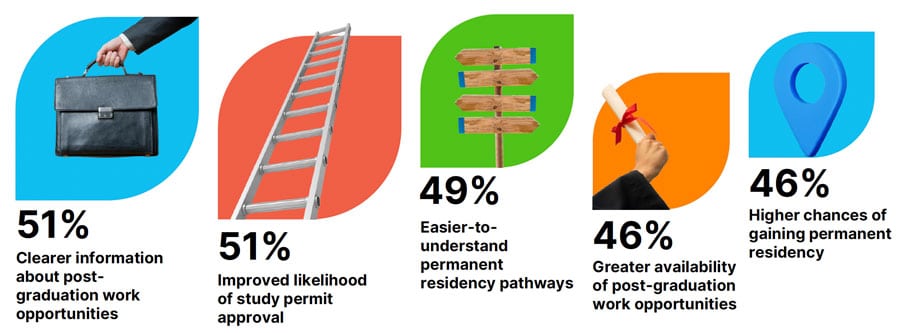
"I think that we have all seen the tremendous decline in approvals of study permits," said Ms Castellanos. "So you can imagine how students are not really trusting our system."
Immigration, Refugees and Citizenship Canada's (IRCC) full-year data for 2024 reveals that only 45% of study permit applications were approved during the year. Put another way, more than half of all applicants were rejected. This compares to an approval rate of closer to 62% of all study permit applications in 2023.
The point being made in the IDP findings is that, in order to restore confidence in study permit processing, the process has to be clearer and with more transparent requirements so that students, parents, and counsellors can better understand how a study permit application will be evaluated. More importantly, if students feel that their applications will be evaluated in a fair and transparent manner and they have a reasonable chance of success, they will be more likely to apply.
If the approval rate for study permits were to return to more historical norms, Ms Castellanos adds, "That will ignite the likelihood of students to be again attracted to Canada. But a lot of students are fearful of applying [at the moment]. And then when they get a rejection, the rejection letter [offers few details why]."
Travelling for education or immigration?
"Canada is increasingly seen more as a pathway to immigration than a destination for education," said Ms Castellanos. "And I think that is a concern. I think this is a signal for all of us in the sector to work together to shift the message to refocus on highlighting Canada's high-quality education."
When asked what they would like to from Canadian institutions and governments to rebuild student confidence in Canada, IDP counsellors and country managers focused on a number of key points.
- The need to rebuild trust in international student markets with transparent and stable policies and visa processing. "It is frustrating to see students with flawless backgrounds get denied," said one IDP country manager.
- The importance of competing on long-term value, including especially the quality of education and work opportunities for students during and after study. This point recognises that students go abroad for education but, increasingly, their choices are guided by expectations around outcomes after graduation and overall return on investment.
- The need for clear career paths for graduates with data from institutions on graduate employment and PGWP outcomes. The implication here is that institutions have an opportunity to strengthen career services, more actively communicate success stories and data for student outcomes, and begin providing those supports to students earlier in their study abroad experience.
- The importance of sector alignment around positive messaging around study in Canada, a renewed commitment to promoting a great experience for visiting students, and providing outstanding support for students from the point of inquiry on.
There is no question that the new policy settings introduced since January 2024 have dampened student demand for Canada. The IDP survey findings clearly demonstrate this, but they also provide a number of important insights for how Canadian educators, stakeholders, and partners can rebuild the confidence of students and their families.
For additional background, please see:







