
Kazakhstan sets its sights on being a regional hub for international students

- Kazakhstan is attracting more international students than ever
- It has an ambitious goal of hosting 150,000 foreign students by 2029
- Foreign collaborations and branch campuses are key pillars in the strategy
As Russia continues to wage war in Ukraine, international students who might once have chosen Ukraine or Russia for higher education are increasingly considering Kazakhstan. The country is hosting record numbers of foreign students () and has a goal of attracting 150,000 international students by 2029.
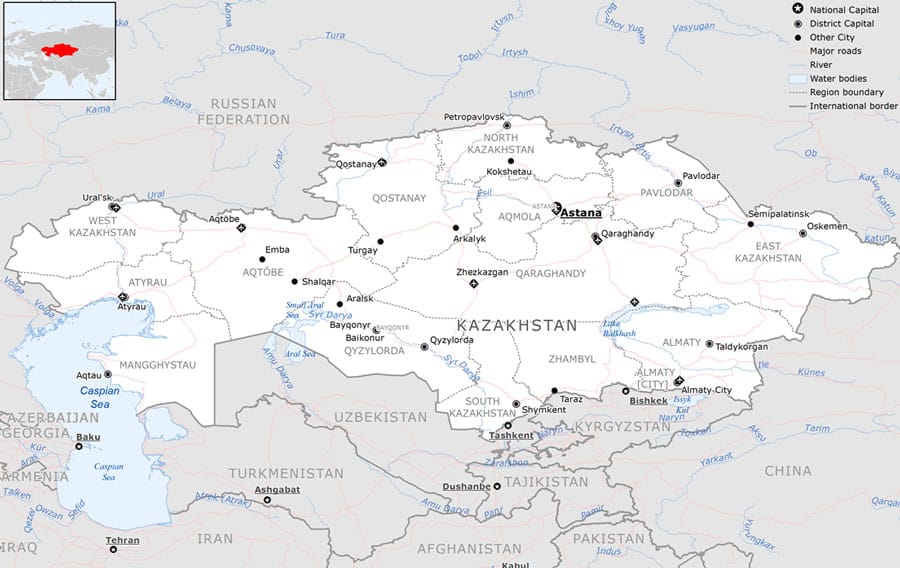
Located mostly in Central Asia (with a small portion in Eastern Europe), Kazakhstan shares borders with Russia, China, Kyrgyzstan, Uzbekistan, and Turkmenistan. Though it is a Russian-speaking nation, Kazakhstan has strong ties with Europe and encourages trade and educational partnerships with Western countries. Its geographical proximity to major outbound student regions (e.g., Asia, the Middle East, and Africa) represents a competitive advantage, especially because Kazakhstan is one of a handful of countries in Central Asia that is both neutral in terms of geo-political affiliations and relatively stable.
As the war in Ukraine has discouraged Western countries to trade and pursue diplomatic relationships with Russia, Kazakhstan has positioned itself as a solid alternative, a strategy emboldened by its strong oil, gas, and minerals reserves. In the past few years, Kazakhstan’s strategic location and neutral geo-political stance has attracted substantial foreign investment in sectors such as pharmaceuticals, automobiles, and food production. This investment is furthering the country’s aim to become more diversified economically.
Party to the Bologna Process
Russia was expelled from the Bologna Process in 2022, making its degrees much less attractive to students interested in having their credentials recognised globally. In contrast, Kazakhstan remains a party to the Process, and it aims to meet its international student target of 150,000 by 2029 in part through partnerships with Western institutions.
Branch campus activity heating up
Already home to 23 branch campuses, Kazakhstan will soon host several more. Universities from countries including Germany, Italy, Türkiye, South Korea, and the UK are set to open branch campuses over the next year. The conditions offered to foreign institutions are often very helpful, with Kazakhstan’s government offering financial support or even rent-free land for campuses setting up joint operations.
In addition, Kazakhstan wants to establish its own footprint in key source markets. The first Kazakhstani branch campus – expected to be Al-Farabi Kazakh National University – is in 2026.
Pakistan is among the top four source markets for Kazakhstan after India, Russia, and China.
Affordability, English-taught programmes, and visas
International students can expect to pay for undergraduate programmes, with English-taught programmes only a bit more costly ($3,000 to $5,000 USD). At the master’s level, public universities charge between . Tuition fees are higher at prestigious private universities and for specialised programmes. The number of scholarships is expanding, as is the number of English-taught programmes.
Living costs are also affordable. The range is about per year for student housing, and US$250 to 500 per month for private accommodation.
Visa rejections are rare, and visa processes and fees are reasonable. The cost of a student visa to ranges from US$50 to 150 depending on country, and many students receive visas within two weeks of applying.
Speaking with , Aray Saniyazova, head of international students and scholars services at Nazarbayev University, said:
“One thing I often hear from students is the smoothness of the visa process, even if some of them have to apply from third countries, as in the case of Nigerian students who apply from Egypt. In our experience, student visa rejections are extremely rare. In fact, we have practically had no cases of refusals for our students. This gives students a strong sense of security and confidence as they prepare for their journey. And once they arrive in Astana, many say they are warmly welcomed.”
It is safe to say that we can add Kazakhstan to the growing list of countries aiming to host more of the world’s mobile students. Within Central Asia, it stands to be the frontrunner.







