
US suspends immigration processing for nationals from 39 travel ban countries – but F, J, and M visa processing will continue

- Students from 39 countries face either total bans or restrictions limiting their ability to enter the US
- Students from those same countries who are currently residing in the US can still apply for immigration benefits or extensions, but their applications are now on indefinite hold
- Those who have received immigration benefits since 20 January 2021 may find their documents re-reviewed, with potential negative consequences
- Nigerians are on the “restricted� list and are subject to the hold and review
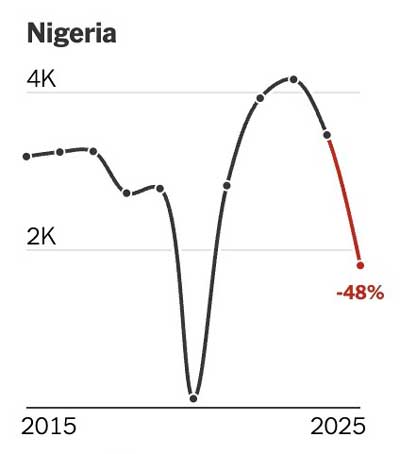
- A New York Times analysis shows that student demand is falling significantly from Nigeria, US educators’ eighth largest source of international students, as well as from other markets including India
Breaking news for 14 January: This article covers the US government travel bans and suspension and review of immigration programmes affecting students (and other nationals) from 39 countries. On 14 January, the government announced an additional decision beginning on 21 January 2026. We can clarify that this additional policy does not apply to non-immigrant visas such as J, F, M, and H. It applies only to immigrant visas. The following article focuses on current US policies that affect international students from 39 countries hoping to come to the US or to extend their stay in the US.
In 2025, the US government imposed, then extended, travel bans and restrictions affecting nationals from countries deemed to be a risk to American interests and security. As of this writing, the list – detailed in Presidential Proclamation (PP) 10998 – is now 39 countries long, including 19 countries whose citizens’ entry to the US is barred and 19 whose citizens face restrictions on entry. The remaining affected group (fully barred) are people who attempt to enter with Palestinian Authority-issued travel documents.
The travel ban and restrictions affect incoming visitors, workers, and students. But the list has other purposes as well. Effective immediately, if a visa holder already in the US is from one of the countries on the list, they face massive hurdles to their ability to secure or extend desired immigration benefits. According to the US Department of Homeland Security’s policy memorandum, ",” they will see their application land in a pile called “adjudicative hold.” In other words, their application will not be processed in the foreseeable future.
This includes people wanting to extend their visa status and students applying for (or hoping to extend) Optional Practical Training (OPT), the post-study work permit for F-1 international students, and those eligible for the 24-month STEM OPT extension. Other visa categories affected by the hold include the H-1B programme and the Academic Training work programme for J-1 visa holders. Adjudications of Green Card applications submitted by nationals of the 39 affected countries are also on hold. While the government states that Green Card replacement requests may be honoured as an “”, are doubtful about this.
Indefinite hold, additional review and vetting
The government has not said how long it plans to suspend the processing of immigration applications for the affected visa-holders. During the pause, it will “conduct a comprehensive review of all policies, procedures, and screening and vetting processes for benefit requests for aliens from [the affected] countries.” Further, US Citizenship and Immigration Services personnel are directed to “conduct a comprehensive re-review of approved benefit requests implicated in PP 10998 that were approved on or after January 20, 2021.”
The reasons given for the pause are that action must be taken to clamp down on “high overstay rates, significant fraud, or both,” as well as the need to protect the security of the United States. In a December press release commenting on Presidential Proclamation (PP) 10998, : “The proclamation’s rationale is based in part on visa overstay rates that are known to be deeply flawed. Using inaccurate data to justify a policy that has such far-reaching consequences for U.S. global engagement is misleading.
“The administration’s latest actions will undoubtedly prevent some of the world’s best and brightest students from contributing to US predominance in research, science, and innovation. This is yet another grave misstep that will have long-lasting consequences on U.S. global competitiveness.”
The case of Nigeria
In all, there are tens of thousands of students affected by Presidential Proclamation (PP) 10998 and the associated suspension of immigration benefits for those already in the United States. The lion’s share of these are Nigerians.
Nigerians – on the restricted list and now subject to immigration document hold and review rules – are not only an increasingly important overall source of enrolments for US higher education institutions (the eighth largest contributor in 2024/25 with 21,850 students enrolled), but they are also a major source of STEM talent.
91ɬÂþ half of all Nigerian students in the US are in STEM fields, and Nigerian students now make up the sixth largest group of international students in (2,785 in 2024/25), following only Indians, Chinese, South Koreans, Nepalis, and Taiwanese. Nigerian students’ importance to US STEM innovation is highlighted by the fact that of those represented in STEM OPT enrolments, India, Nepal, and Nigeria were the only growth markets for US educators in 2024/25.
Trump policies significantly affecting demand or the US
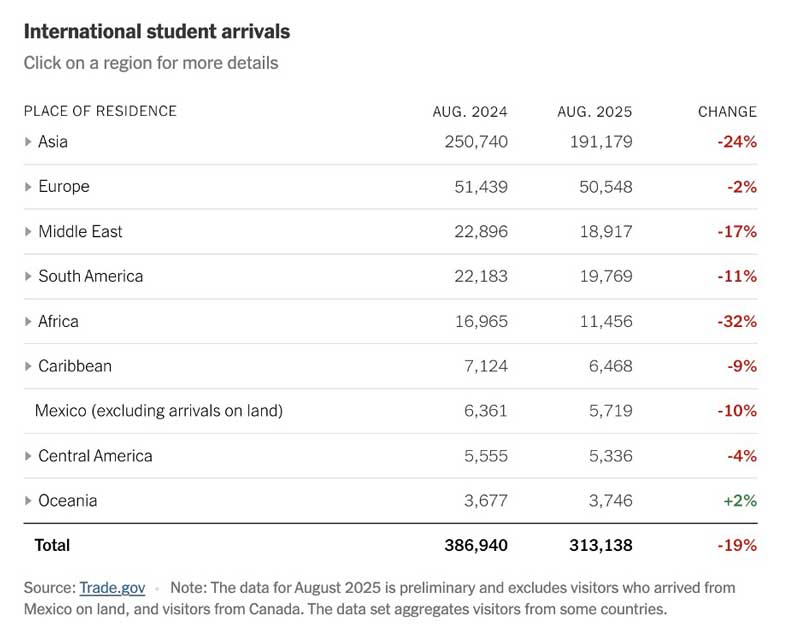
In October 2025, the international student trends in the US under President Trump. Overall, there was a 19% drop in international students travelling to the US in August 2025 versus August 2024. But the falloff was much steeper for some markets:
- India: -44%
- Nigeria: -48%
- Ghana: -51%
The decline from China was not as steep (-12%) but given that China contributes more students than any other country than India, the drop is notable.
The New York Times notes: “Data from SEVIS showed that the fall spike in international student enrollment from countries with a travel ban was nearly 70 percent smaller this year.”
For additional background, please see:







