How and when international students use school websites and social media in planning for study abroad

More than three-quarters (77%) of international students responding to 2019 QS’s International Student Survey said that the most useful source of information for them when researching an institution abroad was the school’s website. The survey – which is the world’s largest pre-enrolment survey of international students – gathered data on how students use a range of information sources, what information they’re looking for, and how social media use is changing. This year’s survey was conducted from November 2018 to March 2019 among over 75,000 students and 71 universities.
Strong website strategy is a must
The crucial role of the school website in students’ research reinforces the importance of creating an attractive, intuitive, and mobile-optimised website that prioritises the information students care about the most. As we have discussed in other articles, key considerations for international students today are:
- Employment outcomes;
- Information on working while studying and work opportunities in the host country after graduation;
- Cost of living, tuition, accommodation, and scholarship/financial aid information;
- Guidelines on visa and university applications that are easy to understand;
- Student testimonials and reviews regarding everything from what it’s like to study at the university and in a host country to teaching quality.
The following graphic from the QS report reinforces many of these points.
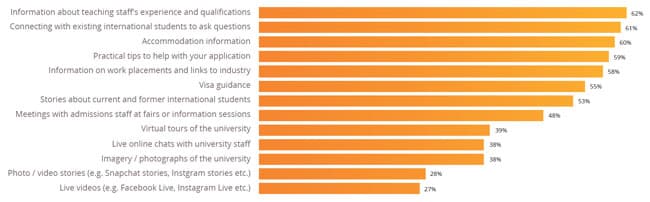
“High quality teaching [is] a key consideration for prospective international students and demonstrates why universities need to be vigilant in updating and promoting their lecturer profiles online. It also showcases how much prospective students value the opinions and experiences of existing international students. Universities should facilitate this by offering several communication channels between prospective students and current students.”
Students also find general search and university rankings useful
After school websites, students found the following to be the most useful tools in their research: general online search (62%), rankings (47%), course finder websites (35%), and institution information sessions/events (33%). Fewer than three in ten students mentioned sources like discussions with university staff (28%), family and friends (27%), and university brochures/prospectuses (26%).
Consider parents in marketing
While university brochures were cited only by a quarter of students, notable is the fact that 22% of students said they read these brochures (or prospectuses) with their parents. This is a significant finding since the survey also found that two-thirds of students are influenced by their parents when making study abroad choices. Other recent research has also emphasised the great influence that parents continue to have on student decision making. When designing and writing copy for brochures, then, marketing staff should therefore keep in mind that their audience includes parents as well as students. Another important finding related to brochures is that students prefer digital formats (51%) to print brochures (20%), and part of the reason for this is that they want to avoid printed brochures because these are less environmentally friendly. Two points arise from this:
- We may be at or near the point where printed marketing material can be greatly reduced;
- Student choice and general outlook is ever more concerned with the environment, a fact that should resonate across the marketing effort as well as on campuses.
Role of social media
Not surprisingly, a great majority (85%) of students said they use social media in their research regarding study abroad, and the survey found that the range of platforms students are accessing has expanded, with YouTube, Instagram, Twitter, and LinkedIn increasing in importance.
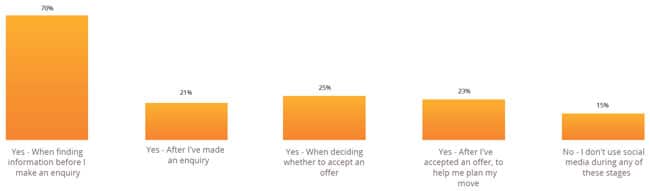
QS provides an interesting breakdown of when students use social media. Seventy percent are turning to social platforms before they make an enquiry, with smaller – but significant – percentages going on these platforms further along in the enrolment funnel.
- Happy, successful students – ideally a mix of domestic and international students;
- Lovely, vibrant campuses;
- Exciting recreational activities;
- Nice accommodation.
Social media is ideally suited for triggering emotion among prospective international students, while other tools – chats with admissions staff, emails, brochures, etc. – can be employed to deliver more detailed, practical information, especially as the student progresses further along the enrolment funnel. For additional background, please see:
- “Survey shows study abroad decision process is changing, with more factors at play”
- “The crucial role of parents in international student recruitment and retention”
- “The enrolment funnel: Better results start with the prospects you already have”
- “Evidence that international students are increasingly prioritising employment outcomes”
- “Let them talk, the power of student reviews”